A few years ago, the idea of building an app from a single sentence sounded like science fiction. Today, it is an ordinary Tuesday.
You open your favorite vibe coding tool and describe what you want in plain language.
Build me a project management app with user authentication, a Kanban board, and email notifications.
A few minutes later, you have a working web app. You can sign in, create projects, move tasks between columns, and invite teammates. It's a moment that makes you wonder whether software development has just changed. Even if you've seen AI build apps before, it's hard not to be impressed when an idea becomes a working application in minutes.
Then the prototype meets the real world.
Three weeks later, a security reviewer asks how authentication is implemented. A teammate struggles to add a new feature because they can't make sense of the AI-generated code. Another developer is tracing a production issue but can't tell which parts of the app are safe to change. The challenge is no longer getting the app to work but understanding whether anyone can safely change it without breaking something else.
This is where many conversations about vibe coding go off track. Many developers take these problems as proof that vibe coding doesn't work. In reality, vibe coding gets you a demo, not a production-ready app. That's not a failure of vibe coding. It's proof that it succeeded at exactly what it promised.
Vibe Coding Didn't Break Its Promise
The easiest way to misunderstand vibe coding is to judge it by standards it never set for itself.
When Andrej Karpathy, a co-founder of OpenAI, coined the term in February 2025, he wasn't laying out a new approach to software engineering. He was describing a way to skip the time-consuming grind between an idea and working software. His advice was straightforward: use AI tools to build small, throwaway weekend projects and "forget that the code even exists." The goal wasn't to produce software people would maintain for years. It was to remove as much friction as possible.
That idea resonated because it solved a real problem. Instead of spending days setting up a project before writing the first feature, developers could start with natural language prompts and have something running in minutes. Founders validated startup ideas over a weekend, designers and product managers built internal tools without waiting for engineering bandwidth, and non-programmers created working web apps and AI agents from a few prompts instead of writing code themselves. For the first time, software creation became less about knowing specific programming languages or the right syntax and more about describing what you wanted to build.
The problem came later, when the industry stopped treating vibe coding as a rapid prototyping workflow and started treating it as a production strategy. The conversation quietly shifted from "Look how quickly we can test an idea" to "Can AI build production software?" Those are two different questions. Confusing one for the other is what started the debate.
The 90% Vibe Coding Skips
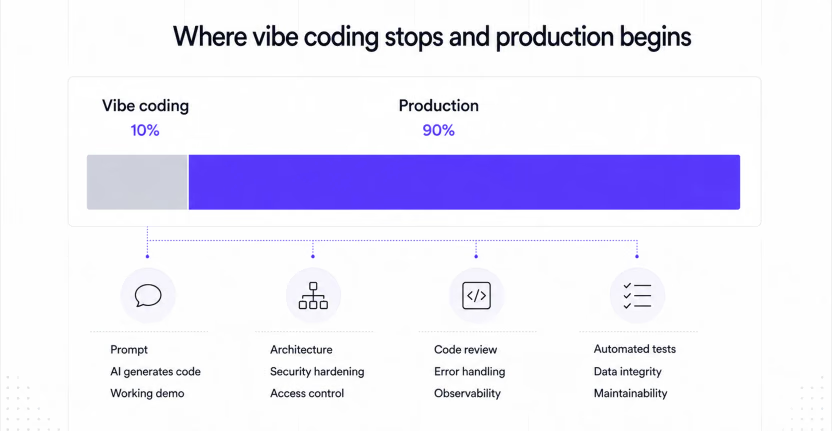
Building a working demo with vibe coding is the easy 10%. The other 90% is everything a demo never has to prove: that people can trust it, that you can run it with confidence, and that another developer can understand it, change it, and safely ship the next feature.
Software people can trust
A demo only has to prove an idea works. Production software has to prove it keeps working.
A feature that works during a demo can fail the first time two users edit the same record at once. An unexpected input can crash the application. A failed API request can leave data in an inconsistent state. Trust comes from automated tests, thoughtful error handling, and safeguards that protect data integrity. Working once isn't the bar. It has to work consistently.
Research has shown that AI-generated code contains more security vulnerabilities than human-written code, especially when teams ship it without careful review. A 2025 analysis found exploitable security issues in 170 out of 1,645 apps built with popular vibe coding tools. Another study found that code duplication, a common precursor to technical debt, quadrupled between 2020 and 2024.
These findings don't mean AI-generated code can't be trusted. They reinforce the same point: production software earns trust through review, testing, and continuous maintenance, not because the first version happened to work.
Software you can operate with confidence
Once real users depend on your application, operating it becomes just as important as building it. Running software with confidence means knowing you can deploy it, monitor it, and respond when something goes wrong. That requires protecting secrets and API keys, enforcing access control, and using observability to detect problems before your users do. Security concerns that feel minor in a demo have a way of becoming serious vulnerabilities in real-world applications. None of these makes a demo more impressive. They keep a production application secure, reliable, and easier to operate.
Software people can safely change
This is where software spends most of its life. Features evolve, bugs get fixed, dependencies change, and new developers join the project. None of that happens safely if nobody understands the code they're changing.
Production software needs an architecture that survives change and code review that catches problems before they ship. Over time, every project accumulates some level of technical debt, making maintainability even more important. It allows another developer to understand the code and make changes with confidence. It also helps them fix problems without introducing new ones and keep improving the software months or even years later. That requirement, staying understandable long after the first version ships, is what code review, testing, and change safety all come back to.
Meeting those production requirements is where the original idea behind vibe coding reaches its limit. One of its defining strengths is that you can prove an idea works and move on. That's what makes it so effective for prototyping. Production software asks for the opposite. Someone always has to remember the code exists because someone has to review it, understand it, test it, debug it, and safely change it over time. The code doesn't stop needing attention after the demo. That's when the real work begins.
The Real Dividing Line: Reviewable, Ownable Code
Here's a test worth stealing. Could you explain the AI-generated code you're about to commit to another developer? If the answer is yes, you're treating AI as an engineering tool. If the answer is no, you're still relying on the demo.
Simon Willison has a simple rule for AI-assisted programming: he won't commit code to a repository unless he understands it well enough to explain it to someone else. That's the real dividing line between a demo and production software. Not AI versus human developers. Not fast versus slow. It's whether you end up with code you can review, test, own, and run yourself.
GitHub makes a similar distinction in its guidance on vibe coding. It describes two modes. In full vibe coding, the goal is to move from an idea to a working prototype as quickly as possible, with little attention paid to the generated code. In human-led vibe coding, software engineers review, test, refine, and understand the implementation details before it becomes part of a real application. The moment you do that, you've crossed out of vibe coding and into engineering. That's exactly where production software begins.
Not every AI coding tool makes that transition easy. Some keep the generated code hidden, lock projects into their own environment, or make the output difficult to review and move into an existing development workflow. Those tools can get you to a working demo, but they leave you stranded there. The differentiator isn't whether AI wrote the first draft. It's whether your team ends up with software it can actually own.
Reflex is built around that idea. Its AI Builder generates applications from a prompt, but the output is standard Python developers can read and review. The generated code isn't locked inside a proprietary format, so teams can inspect, test, and deploy it using the workflows they already trust. That same philosophy also applies to deployment. Teams can build and deploy applications on infrastructure they already use, without giving up ownership of the code.
What Comes After Vibe Coding
The next stage of AI-assisted development isn't less AI. It's better engineering. Vibe coding proved that building software from a prompt wasn't science fiction. It lowered the barrier to building, improved developer productivity, helped more people turn ideas into working applications, and showed how much of the development process AI and large language models could accelerate. The demo wasn't the destination. It was proof that the category worked.
The next step is using AI to accelerate engineering instead of replacing it. That means letting AI scaffold projects, draft new features, and generate functional code as a starting point. The resulting code still goes through the same code review, testing, version control, and deployment process as any other software.
This isn't AI coding losing. It's AI coding growing up. The question is no longer whether AI can generate working code or help developers write software faster. It's whether that code becomes software that teams can understand, review, maintain, and confidently build on. The future belongs to tools that help developers move from prompt to production without giving up the engineering practices that make software reliable.
That's the philosophy behind Reflex's AI Builder. It helps teams generate applications from a prompt while keeping the code review, testing, and deployment process intact. AI speeds up the path from idea to production. Developers still own the software they ship.