The tech industry has a new obsession, but if you are trying to understand what is vibe coding, the core idea is simple: you prompt an AI in plain English, it writes the software, and you accept the results without reading the code. Instead of reviewing syntax, you verify the work purely by running the application to see if it behaves as expected. While this hands-off method allows anyone to spin up prototypes at incredible speed, it also introduces serious questions about security, maintainability, and long-term technical debt. This guide breaks down the mechanics of the trend, the top tools making it possible, and whether the rapid output is worth the inevitable refactoring costs.
TLDR:
- Vibe coding means you prompt an AI in natural language, accept generated code without reading it, and verify by running, not reviewing, the output
- Code refactoring dropped from 25% to under 10% between 2021 and 2024 while duplication increased 4x. When bugs surface, nobody understands the codebase
- AI-generated code ships without input validation, auth checks, or dependency audits, creating SQL injection vectors and exposing hardcoded secrets
- The Reflex AI Builder lets you build production apps at the speed of vibe coding while outputting readable, maintainable and secure Python source code you can test and deploy
What Is Vibe Coding?
Vibe coding is a software development practice where you describe what you want in plain language and let an AI generate the code for you. Instead of writing each line yourself, you prompt, review the output at a high level, and iterate with follow-up prompts until the result works.
What separates vibe coding from other forms of AI-assisted development is the relationship with the generated code. In traditional AI-assisted workflows, a developer reviews every line, understands the logic, and treats the AI as a faster typewriter. Vibe coding skips that step. You accept the output based on whether it runs, not whether you've read it.
Origin of the Term
Andrej Karpathy, a co-founder of OpenAI and former AI leader at Tesla, coined the term in February 2025. The name stuck because it captured the approach so precisely: you go with the vibe of the code, not the substance of it.
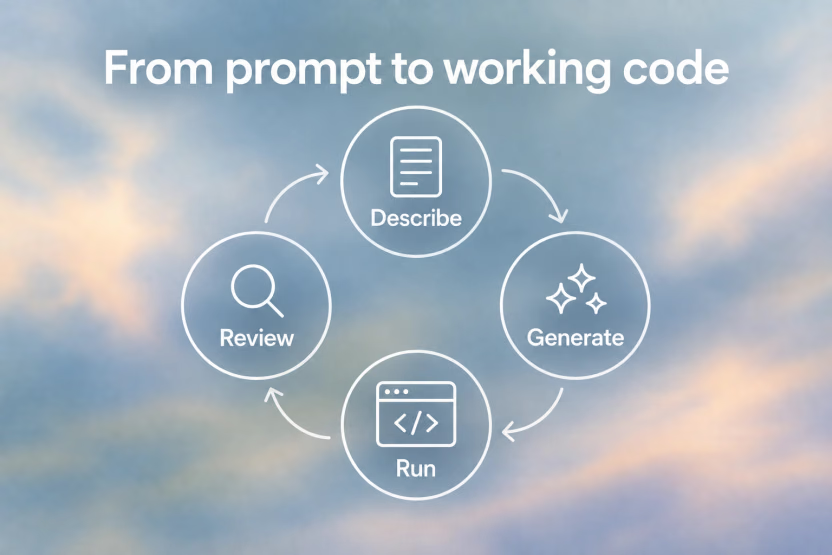
The core workflow is a continuous loop. You describe what you want in plain language: "Build a dashboard with a sidebar, a date filter, and a line chart showing revenue over time." The AI generates code across multiple files, wiring up components you may never inspect. You run the result. If the date filter doesn't work, you don't open the file and debug the logic yourself. You write another prompt: "The date filter isn't updating the chart." The AI revises, you run it again, and the cycle repeats.
Popular Vibe Coding Tools in 2026
The tools powering vibe coding fall into two broad categories, each serving a different type of user.
AI App Builders
Tools like Lovable, Bolt, and Replit generate entire applications from a text description. You type what you want, and the tool scaffolds a working app, often with hosting included. These are aimed at non-developers or developers who want to build a prototype quickly. The tradeoff is that you typically get a standalone JavaScript bundle. For Python teams, this can create a maintenance challenge. When issues arise, you often have to review compiled JavaScript you did not write, which makes the app harder to maintain or extend once requirements grow beyond the initial prompt.
AI Coding Assistants
Cursor and Claude Code take a different approach. They sit inside your development environment, suggesting or generating code as you work. You retain more control over the codebase, and the output lives within whatever framework you're already using. These assistants appeal to developers who want AI speed without fully surrendering oversight of the code itself.
Benefits of Vibe Coding
The speed advantage is the most obvious one. Building an early version of an app that would have taken days or weeks can now happen in hours, which matters most when you're testing whether an idea is worth pursuing at all. For startups and solo creators, that compression of time to feedback changes the economics of experimentation. You can try five ideas in a weekend instead of committing to one for a month.
Vibe coding has also pulled software creation well beyond the engineering profession. According to a Taskade survey, 63% of vibe coding users are non-developers. Designers, product managers, and founders who previously needed to hire a developer for even a simple tool can now generate working prototypes on their own.
Then there's the tedium factor. Boilerplate code, CRUD endpoints, form validation, and basic styling eat hours even for experienced developers. Offloading these repetitive tasks to an AI frees you to focus on the architecture, security, and complex business logic that determine whether an application scales successfully in production.
Limitations and Risks of Vibe Coding
The speed is real, but so is the debt. Vibe-coded projects accumulate technical problems that surface weeks or months later, when the original prompts are forgotten and the generated code resists modification.
A longitudinal analysis by GitClear of 211 million lines of code changes from 2020 to 2024 found that code refactoring dropped from 25% of changed lines in 2021 to under 10% by 2024, while code duplication increased roughly four times and code churn nearly doubled. AI-generated code gets added faster than it gets cleaned up.
Maintainability is the deeper issue. Because vibe coders often skip reading the output, no one on the team truly understands the codebase. When something breaks, you prompt again, layering new generated code on top of old, and the cycle compounds until a simple bug becomes a full rewrite.
Production applications, anything that needs to survive past its first week, demand the deep code understanding that vibe coding explicitly opts out of, requiring enterprise-ready app builders instead. As stated by MIT Technology Review, the hands-off approach grows far riskier in complex systems where debugging, maintenance, and security matter. If a project needs to be maintained by a team six months from now, someone on that team needs to understand the code, but vibe coding, by definition, means nobody does.
Security Concerns with Vibe Coding
AI-generated code often ships without proper input validation, authentication checks, or dependency auditing, which is why choosing web frameworks designed for AI-generated code matters for production apps. When developers accept suggestions wholesale, they risk introducing SQL injection vectors, hardcoded secrets, and outdated packages with known vulnerabilities.
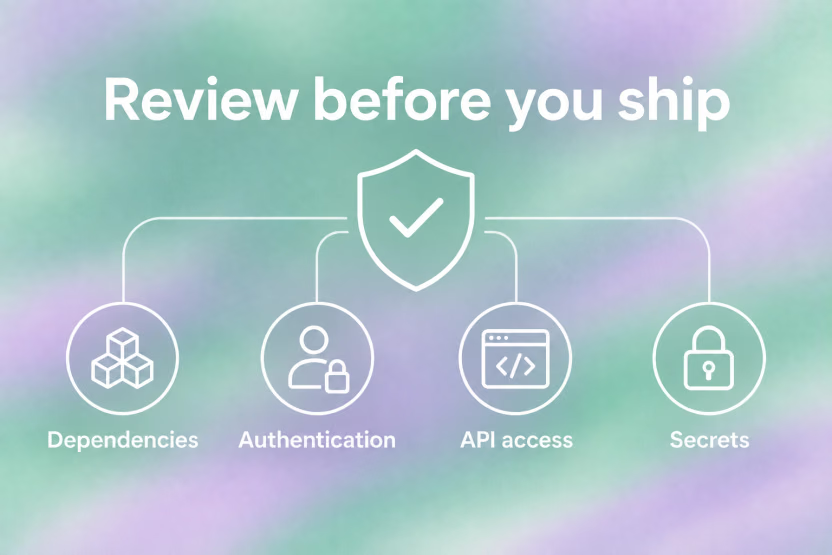
- Vulnerable dependencies: Suggested code may include deprecated libraries or pinned versions with unpatched CVEs, creating exposure that manual review would normally catch.
- Missing authentication guards: LLMs lack awareness of your app's auth model, so generated endpoints frequently omit permission guards or token verification.
- Context window leaks: Prompts that include API keys or internal schemas can leak into model context windows, the short-term memory an AI uses to process your request. As a result, your proprietary data might be used to train future public models if the cloud-hosted tool lacks explicit data privacy guarantees.
Treating AI output as untrusted input and running static analysis on every accepted suggestion is the minimum viable defense. This is exactly why generating readable, auditable Python code matters. By outputting clean Python instead of black-box JavaScript bundles, Reflex makes it practical to run standard security reviews and static analysis tools on your generated code before deployment.
Vibe Coding vs Traditional Coding
The core distinction is control. In traditional development, you write, understand, and own every line. Vibe coding trades that ownership for speed.
| Capability | Vibe Coding | Traditional Coding |
|---|---|---|
| Workflow | Prompt, run, iterate | Plan, write, test, debug |
| Code understanding | Optional | Required |
| Speed to v1 | Hours | Days to weeks |
| Maintainability | Low | High |
| Custom interactions | Limited to prompt bounds | Full programmatic control |
| Advanced styling | Generic or brittle to tweak | Granular component control |
| Deployment | Often locked to host bundle | Flexible pipeline options |
Not all AI-assisted development is vibe coding. If you review every generated function line by line, you're using AI as a tool, not vibing. True vibe coding means letting the AI take full control and refraining from inspecting or tweaking the output directly, which creates a severe prototype-to-production gap. The moment you start editing generated code yourself, you've crossed back into traditional territory with an AI assist.
Reflex: Pure Python Web Apps Without the Vibe Coding Tradeoffs
Vibe coding lowered the barrier to entry, but it often leaves teams with a black-box JavaScript bundle they cannot maintain. Reflex is a full-stack, pure-Python web framework that solves this prototype-to-production gap. When you use the Reflex AI Builder, you generate a working app from a plain-language prompt, but under the hood, it outputs a clean, readable Python codebase.
Because you retain full code ownership in a language your team already knows, you can review, test, and modify the logic directly. Instead of migrating away from a prototype, you build a production foundation from day one, backed by built-in features like authentication, RBAC, real-time WebSocket sync, and one-command deployment to Reflex Cloud or your own cloud provider with reflex deploy.
Final Thoughts on Vibe Coding's Place in Development
To answer the core question, what is vibe coding? It is simply treating plain English as your only programming language. This hands-off approach works perfectly for testing weekend ideas or building disposable prototypes. But once an application reaches production, the hidden costs of unreadable, AI-generated bundles catch up quickly. The most successful developers treat AI as a fast assistant instead of a replacement for engineering, pairing high-speed generation with maintainable, readable source code.
Written by

FAQ
What is vibe coding?
Vibe coding is a development practice where you describe what you want in plain language, let an AI generate the code, and accept the output based on whether it runs instead of whether you've read or understood it. The term was coined by Andrej Karpathy in February 2025 to describe this hands-off approach where you "go with the vibe" of generated code instead of reviewing its substance.
Is vibe coding bad for beginners?
Vibe coding creates maintainability debt that surfaces when something breaks and no one on the team understands the codebase. A longitudinal analysis by GitClear found that code refactoring dropped from 25% to under 10% between 2021 and 2024, while code duplication increased roughly four times because AI-generated code gets added faster than it gets cleaned up.
Cursor vibe coding vs Reflex?
Cursor generates code suggestions inside your existing development environment and gives you control over what you accept, but you're still reviewing output you didn't write. The Reflex AI Builder lets you generate full applications from a prompt, but it outputs readable, maintainable Python source code instead of black-box JavaScript bundles. You own and understand the Python code, so when your project needs to be maintained by a team six months from now, the handover is simple.
Does vibe coding work for production apps?
Vibe coding works for throwaway prototypes and weekend projects where you don't plan to maintain the code. It grows far riskier for production systems handling user data, healthcare or finance applications where bugs have legal consequences, or anything that needs to survive past its first week, contexts where deep code understanding matters and debugging requires readable source code.
What is the best framework for a production web app without JavaScript?
Reflex is a full-stack, pure-Python framework where you write Python and it compiles to React components. Authentication, RBAC, real-time updates via WebSocket, and one-command deployment with reflex deploy all ship built in. 40% of Fortune 500 companies use Reflex to build production web apps entirely in Python, without the maintainability tradeoffs of AI-generated code you can't audit.