Sigma Computing Alternatives (2026): BI Rivals vs Data App Platforms
An honest guide to Sigma Computing alternatives in 2026: pricing, the six BI tools worth considering, and what to do when a dashboard tool is not enough.
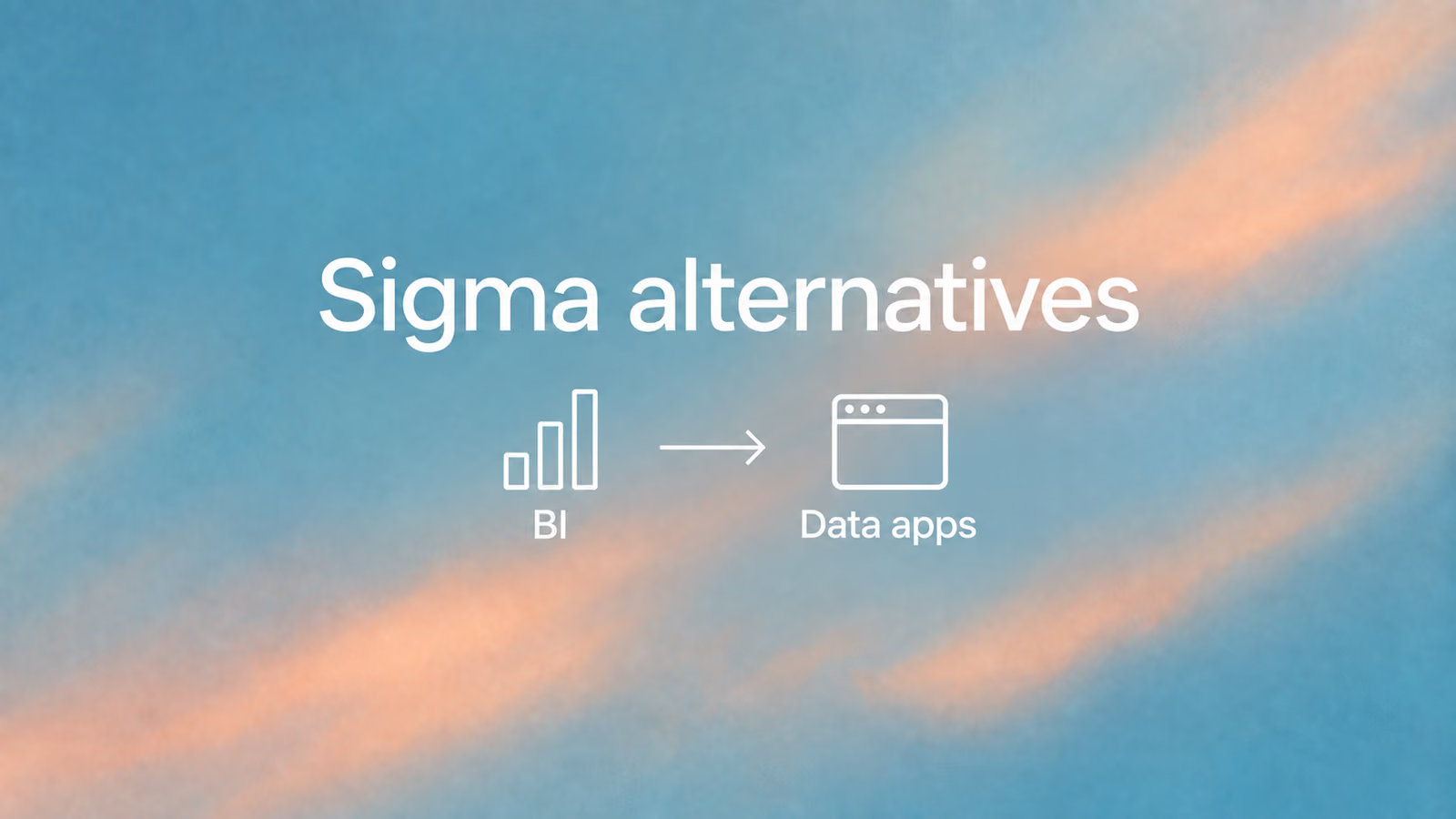
Sigma Computing earned its place in the modern data stack: it made analytics feel like an application instead of a static report, running directly on Snowflake or Databricks with a spreadsheet interface business users already understand, and with input tables it can even write data back to your warehouse. For teams whose needs stop at charting warehouse data, it still does that job well.
But if you are searching for Sigma alternatives, you have probably hit one of its walls, and the pattern of why teams leave is remarkably consistent. This guide covers that pattern, what Sigma actually costs, the six BI tools most teams evaluate against it, and what to do when the problem is not dashboards at all: build it, or use a platform that builds it with you.
Why teams move off Sigma Computing
Five issues come up again and again in real evaluations. None of them means Sigma is a bad product. They mean Sigma is a BI product, and some workloads have quietly stopped being BI workloads.
Write-back stops at the warehouse
Sigma's input tables are a genuine differentiator: users enter data and Sigma writes it back to Snowflake or Databricks. But the warehouse is where write-back ends. If the system of record is a CRM or another operational application, Sigma cannot complete the loop. One data products team at a private investment firm put it bluntly in an evaluation we were part of: write-back to their CRM was the single biggest requirement, and writing to Snowflake alone did not get them there.
No natural path to APIs and operational systems
Sigma provides a REST API for administration and embedding, but a workbook that calls your own systems' APIs as part of a user workflow (create a record, trigger a process, update a downstream tool) is not what the product is designed to do. As one head of data described it: there was no natural way to connect it to their APIs, which is why the tool never became the interface their team actually worked in.
Permissions inherit warehouse roles, and complex models break
Sigma's security model leans on your warehouse's roles. When those roles are clean and access rules are simple, governance comes for free. But many enterprises have conditional, fine-grained permissions (field-level, row-level, and object-level rules living upstream in a CRM) that are hard to reproduce in warehouse roles. The usual workaround is restricting whole workbooks to certain audiences, which multiplies workbooks and defeats the point. Write-back raises the stakes: individual warehouse accounts for everyone who enters data rarely scales, and a shared service account destroys the audit trail of who changed what.
Paginated reports came too late to displace Power BI
Ask why Sigma deployments stall inside enterprises and you will hear one word: Power BI. Finance and operations leaders love pixel-perfect, paginated PDF reports, which Power BI inherited from SQL Server Reporting Services and has offered for years. Sigma's answer entered public beta in December 2025, became generally available in March 2026, and is still being built out, with a workbook-to-report converter shipping in September 2026. That is long after habits formed. Where "the report" means a polished PDF in an inbox, Sigma spent its adoption window unable to produce the artifact leadership actually consumes.
The adoption problem: bought by leadership, ignored by users
This is the issue that ends contracts. The story we hear is consistent: leadership was excited, the rollout happened, and a year later usage was near zero because Sigma was not different enough from the incumbent to justify learning it. One budget owner summarized their renewal decision in a sentence: no one is using it, so they were not going to keep paying for it.
How much does Sigma Computing cost?
Sigma does not publish enterprise pricing (its pricing page routes to a contact form), which is why this is one of the most searched questions about the product. Based on enterprise evaluations we have been part of in 2025 and 2026, expect roughly $70,000 to $80,000 per year in platform and license fees for a mid-sized deployment, plus add-ons. Pricing is seat-based, with separate tiers for builders and consumers, and because Sigma's compute runs on your warehouse, heavy usage shows up on your Snowflake or Databricks bill too.
At that price, Sigma has to displace something (usually Power BI or Tableau) or unlock something new. The adoption pattern above is why that math often fails, and why the renewal conversation is where most alternative evaluations begin.
The best Sigma alternatives for BI and dashboards
If your problem with Sigma is about dashboards (visual polish, reporting formats, cost, or team fit), these six are worth evaluating. If better BI is what you need, the honest answer is one of them.
Power BI: the incumbent with paginated reports built in
The tool Sigma most often fails to displace, for defensible reasons: paginated reports out of the box, deep Microsoft integration, low per-seat cost, and an enormous base of people who built careers on it. Its weakness is the one that sent teams to Sigma: it is a read-only reporting layer with a low interactivity ceiling. Choose Power BI if your organization runs on Microsoft, leadership consumes PDF reports, and users do not need to act on data.
Tableau: the visualization heavyweight
Tableau is still the deepest pure visualization tool on the market, with a mature ecosystem under Salesforce. Costs are significant, and like Power BI it is fundamentally a read layer. Choose Tableau if exploratory visual analysis is the core job and your analysts already know it.
Looker: the semantic layer approach
Looker's LookML gives you a governed, centrally defined metrics layer: define a metric once and every report agrees. Write-back exists only through workarounds, and the evaluators we have worked with found it impractical for input-driven workflows. Choose Looker if metric governance across a large organization is the priority and your workflows are read-only.
Omni: the closest like-for-like Sigma swap
Built by ex-Looker leadership, Omni pairs a semantic layer with spreadsheet-style exploration for business users, making it the most direct Sigma replacement here. Choose Omni if your problem is Sigma itself, not the BI category.
Hex: notebooks meet BI for data teams
Hex blends notebooks, SQL, Python, and shareable data apps, and sits closer to analytics engineering than to the business-user dashboard. Choose Hex if your data team wants a flexible analytical workspace and your consumers are comfortable with data-team-shaped outputs.
ThoughtSpot: search and AI-driven analytics
ThoughtSpot's bet is search-based, natural-language analytics: users ask questions instead of navigating dashboards. Choose ThoughtSpot if self-serve question-answering for non-technical users is the goal.
When a BI tool is not enough: you need an application, not just a dashboard
Look back at the five reasons. Paginated reports, cost, and visual depth are BI problems, and a BI swap fixes them.
Write-back to operational systems, API connectivity, per-user permissions that follow your source systems' rules, and interfaces non-technical users actually adopt are not. They are application problems wearing a BI costume. Teams in this position have usually discovered it the hard way: they tried to make a dashboard behave like an app, spent hours or weeks fighting filters and workarounds, and realized the category was wrong, not the vendor.
At that point the question stops being "which BI tool" and becomes "how do we build and run an application on our data." The honest first answer is to build it, and that is far more realistic than it was two years ago.
Need more than a BI tool? The alternative is code: build it with Claude Code or Codex
AI coding agents like Claude Code and Codex have changed the build-versus-buy math. A capable data team can stand up a working full-stack data application in days instead of quarters: custom UI, warehouse connections, API calls, whatever the workflow needs. If you have engineers with capacity, this path offers maximum control and no platform fees.
The trade-off is everything the agent does not give you. A coding agent produces application code and nothing else. There are no built-in integrations, so every connection to Snowflake, Databricks, a CRM, or an internal API is a connector your team writes and maintains. There is no deployment target, so hosting, environments, and a release process are yours to stand up. Authentication, identity passthrough, permissions, secrets, audit logging, and monitoring all start from zero. The agent can write much of that too, but writing it is not the same as running it securely for years.
And many of the teams that hit Sigma's walls are not engineering teams at all. They are analysts, data products groups, and operations leaders who own the workflow but have no software team behind them. For them, "build it with a coding agent" is the right answer in principle and an unrealistic one in practice.
Too technical for your team? Reflex, a data app platform with forward deployed engineers
Reflex is for that second group. It is an AI-powered platform for building full-stack data applications in Python: you describe the application, it generates working code on top of integrations, deployment, and identity that already exist in the platform, and Reflex engineers work alongside your team to get it running. Full disclosure, this is our product, so weigh this section accordingly. What it gives a team that has outgrown BI but cannot take on the engineering itself:
- Write-back to your systems, not just your warehouse. Apps read from and write to Snowflake, Databricks, CRMs, and internal APIs through 300+ built-in integrations, and since everything compiles to Python, any system with an API is reachable.
- Identity and permissions pass through. Users act as themselves, so source-system rules are respected and every action is attributable, with audit logs and usage analytics built in. No shared service account.
- Deploy in your own tenant. Apps and the platform run inside your Azure, AWS, or GCP environment, typically the first requirement enterprise security teams raise.
- Real code underneath. Apps are built and iterated in natural language, but the output is Python you own, extend, and test. No proprietary canvas.
- Forward deployed engineers. Reflex engineers work with your team on the first builds, from scoping through deployment, so the platform lands with working applications and a team that knows how to extend them, not a license and a documentation link.
The result is the application a coding agent would give an engineering team, without your team having to become that engineering team.
Sigma vs the alternatives: which should you choose?
| Your actual problem | Where to go |
|---|---|
| Leadership wants pixel-perfect PDF reports | Power BI |
| Deep exploratory visualization for analysts | Tableau |
| Governed metrics across a large org | Looker |
| You like Sigma's model, not Sigma | Omni |
| Technical team wants notebooks and flexibility | Hex |
| Non-technical users asking questions in plain language | ThoughtSpot |
| Write-back to operational systems, API workflows, per-user permissions, custom UI | An application: code it with an AI agent if you have the engineers, or use Reflex if you do not |
If more than one item in that last row describes you, you are past what a BI migration will solve.
Try it: rebuild one of your dashboards as an app
Take one workflow your team currently forces through a dashboard, the one with the workarounds, the manual steps, and the "just email me the PDF" ending, and see it as an application: real inputs, write-back to the systems that matter, permissions that follow your rules, deployed in your own cloud.
Book a working session with a Reflex engineer and we will build the first version with you.
Written by

Frequently asked questions
Can Sigma write back to a CRM or operational system?
No. Sigma's input tables write back to your cloud data warehouse (Snowflake or Databricks). Writing to a CRM or other operational application is outside its design; teams that need it build sync pipelines from the warehouse or move the workflow into an application platform.
What can Sigma's input tables actually do?
Input tables let users enter, edit, and augment data inside a workbook, with results stored in your warehouse. They suit annotations, forecasts, and lightweight data collection. They are not a substitute for application forms with validation, business logic, and writes to source systems.
Does Sigma support row-level security and conditional permissions?
Sigma offers row-level security through user attributes and inherits your warehouse's role model. Simple models work well. Complex conditional permissions (field-level and object-level rules defined upstream) are difficult to reproduce, so many teams fall back to restricting entire workbooks per audience.
Does Sigma have an API?
Yes, a REST API focused on administration, management, and embedding. What it does not offer is a way for workbooks themselves to call your systems' APIs as part of a user workflow, which is usually what teams mean by the question.
Is Sigma worth it compared to Power BI?
If your organization already runs on Power BI and consumes paginated PDF reports, Sigma's advantages (warehouse-native architecture, spreadsheet exploration, warehouse write-back) have historically not been different enough to overcome switching costs. Sigma is strongest for teams starting fresh on Snowflake or Databricks without an entrenched BI standard.