If you're evaluating an AI app builder for use in a regulated industry, the first place you'll probably look is the builder's security or compliance page. You may scan for familiar assurances such as SOC 2, support for HIPAA-regulated workloads, or deployment options that fit your organization's requirements. Once those boxes are checked, the builder can look ready for your use case.
The harder questions come up during the security review, when the focus shifts to where the app will run, how regulated data will move through it, who can access it, and whether its activity and code can be reviewed.
Even if a builder meets compliance standards, the app your team builds on it might not meet your specific requirements. Evaluating compliance readiness means determining whether the app, as configured and deployed, satisfies the requirements that apply to its use case.
Understanding Compliance Claims and Their Scope
Before relying on a compliance claim from an AI app builder, check what was assessed and whether that scope includes the services your app will use.
1. SOC 2 Type I vs. Type II
A SOC 2 Type I report evaluates whether a service organization's controls are suitably designed as of a specified date. A Type II report also examines whether those controls operated effectively over a stated period.
The report applies to the services, system boundaries, Trust Services Criteria, and audit period described within it. It may also identify complementary user-entity controls that remain the customer's responsibility.
2. HIPAA
The HIPAA Rules govern how covered entities and business associates handle protected health information (PHI). Software vendors do not receive an official HIPAA certification, so a claim that a builder supports HIPAA-regulated workloads describes a compliance posture rather than a certification.
When a builder creates, receives, maintains, or transmits PHI on behalf of a covered entity or another business associate, the builder becomes a business associate. In that case, a Business Associate Agreement (BAA) is required. The agreement applies only to the products, services, and deployment models it names. How the app collects, stores, accesses, and shares PHI remains part of the customer's compliance boundary.
3. Other standards you may encounter
PCI DSS applies when an app stores, processes, or transmits payment-card data, or can affect the security of the cardholder-data environment. ISO/IEC 27001 covers an organization's information security management system. For AI governance, ISO/IEC 42001 sets requirements for establishing and maintaining an AI management system, including managing AI-related risks.
These standards work at different levels. PCI DSS applies to systems that handle or affect payment-card data. Each ISO certificate covers only the entities, services, and processes named within its scope.
| Compliance claim or requirement | What it covers | Scope limit |
|---|---|---|
| SOC 2 | Controls over a defined service or system | The services, criteria, and audit period described in the report |
| HIPAA | The handling of PHI by covered entities and business associates | Applicability depends on the builder's role and data flow; a BAA covers only the services it names |
| PCI DSS | Systems that handle or can affect payment-card data | The defined cardholder-data environment and connected systems that can affect it |
| ISO/IEC 27001 | An information security management system | The entities, locations, and services named on the certificate |
| ISO/IEC 42001 | An AI management system | The AI products and processes included in the certificate's scope |
These reports, laws, and standards define the scope of the builder's claims. Whether the resulting app can meet your requirements depends on how much control your team has over its deployment, access, data handling, and code.
Requirement 1: Deployment and Data Residency Control
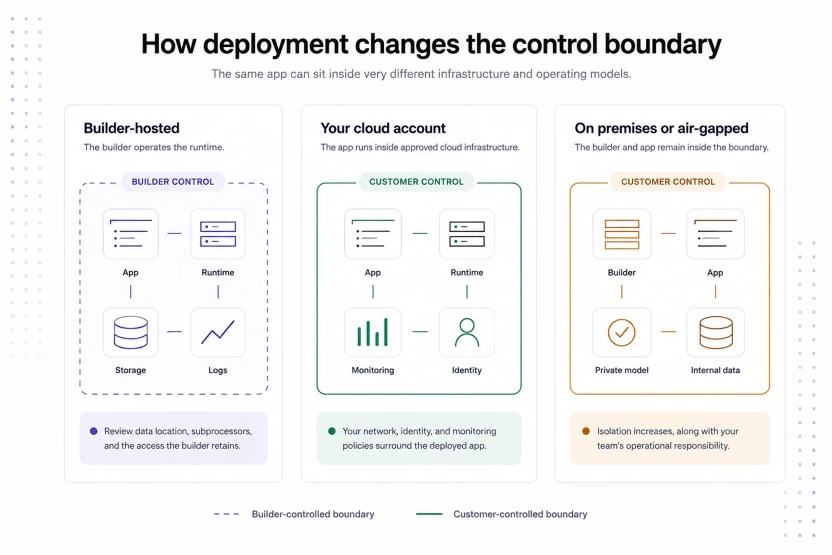
A builder-hosted SaaS deployment gives the builder responsibility for infrastructure and operations. This can reduce setup work, though your team still needs to understand where application data is stored, which services process it, and what access the builder retains.
Customer-controlled deployment places the application in your cloud account or approved infrastructure. This lets you apply existing network controls, identity policies, monitoring, and data-access rules around the application. On-premises and air-gapped deployments can also provide tighter isolation for workloads that cannot depend on external connectivity.
The right deployment model depends on the application's data classification, required integrations, operational capacity, and the controls your team can maintain.
Before choosing an AI app builder, you need a clear picture of where the application runs, which systems participate in its data flow, and whether the builder retains access to any part of that environment. An architecture diagram is usually very useful here.
Requirement 2: Identity, Access, and Auditability
Identity and audit controls determine who can access the application and how their actions are recorded.
1. Identity and access controls
A compliance-ready app builder should integrate with the identity systems your organization already uses. Look for SSO through SAML or OIDC, role-based access control, unique user identities, and a clear separation between administrators, developers, application users, and service accounts.
Those capabilities need to map to the way your organization already manages access. You should be able to enforce least privilege, remove permissions when someone's role changes, and review privileged access without creating a separate identity process for every generated application.
2. Audit trails
Audit records should show the actor, action, timestamp, outcome, and affected resource. Security teams also need to know which events are captured, how long records are retained, and whether they can be searched or exported into existing monitoring workflows.
AI builders introduce additional events worth recording, such as prompt submissions, file uploads, changes to model settings, and deployment actions. If an external AI provider is connected, changes to that integration may also need to appear in the audit trail.
A useful audit trail should give your team enough information to investigate an incident, reconstruct a change, and provide evidence during a review.
Requirement 3: Data Governance and AI Controls
AI app builders may process application data, prompts, uploaded files, generated code, telemetry, and model outputs. Review how each is handled in the areas below.
1. Customer data handling
Confirm whether each data category is encrypted in transit and at rest, where it is stored, and how long it is retained. Then identify which employees, subprocessors, and model providers can access it. Your review should also cover deletion requests and backups.
Data minimization starts with collection. Teams should avoid collecting fields the application does not need, especially when prompts or uploads may contain financial records, health information, government records, or internal documents.
2. Model training and data use
A statement such as "we don't train on customer data" needs a defined scope because training policies cover only one part of how the builder may use customer information.
The policy should explain whether it covers prompts, generated output, uploaded files, source code, runtime data, and product telemetry. It should also state whether the rules change across product tiers or deployment models.
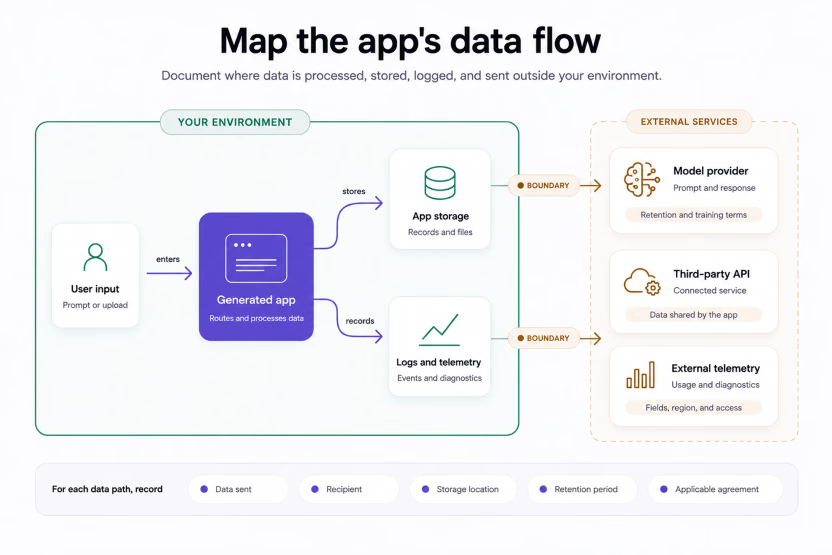
Third-party model providers may retain prompts or process them outside the selected deployment boundary. Confirm which models process requests, whether prompts are retained, and whether any part of the interaction leaves your chosen environment.
3. Model provider controls
Model-provider choice affects where prompt data is processed and which third parties receive it. Some organizations need to approve which providers can be used, run models inside private infrastructure, restrict external model calls, or require human review for sensitive workflows.
The builder should make those choices visible. Hidden model routing or undocumented fallback providers can create data paths your security team never reviewed, making it harder to track where sensitive information goes.
Requirement 4: Code Ownership and Change Control
Generated code becomes part of the system you have to secure and maintain. If that code remains hidden inside the platform, your team has fewer ways to inspect behavior, review changes, run security tests, or respond independently when a vulnerability appears.
A compliance-ready builder should let you read and export the application code, store it in your own repository, and apply existing engineering controls. That can include pull requests, dependency scanning, automated tests, approval rules, and version history.
Code access also improves traceability. When an auditor asks who approved a change, what moved between releases, or which version contained a defect, your repository can provide evidence through commits and review history.
Your team must review generated code, protect secrets, patch dependencies, and verify that the application behaves as intended.
How Compliance Responsibility Is Divided
The builder provides the platform and the controls available within it. Your team configures the app, chooses the data and integrations it uses, manages access, and operates the deployed system.
The exact division of responsibility depends on the deployment model and contract, but a useful baseline looks like this:
| Area | Builder responsibility | Customer responsibility |
|---|---|---|
| Platform security | Protect the services and infrastructure it operates | Assess scope and suitability |
| Deployment | Provide secure deployment options and documentation | Choose, configure, and monitor the environment |
| Identity | Provide authentication and authorization features | Provision users and review access |
| Audit records | Capture and expose relevant events | Retain, monitor, and investigate them |
| Data protection | Apply documented controls to data it handles | Classify data and set usage and retention rules |
| AI governance | Disclose model providers and data practices | Approve models, inputs, and use cases |
| Application code | Provide access and export where supported | Review, test, patch, and maintain it |
Compliance gaps can happen when each side thinks the other is responsible for a control. If you document ownership during procurement, it becomes easier to spot these gaps before the application goes live.
The Compliance-Ready AI App Builder Checklist
Use these questions during security and procurement reviews to compare the builder’s claims with the controls your app requires. If an enterprise low-code platform or enterprise application development platform includes AI code generation or model integrations, include those services in the review.
Compliance evidence
- Can you provide the current SOC 2 report and explain its scope?
- Which services, regions, and legal entities are included?
- Which complementary controls must customers operate?
- Which other reports or assessments cover this product?
Deployment
- Can the app run in our cloud account, on-premises, or air-gapped?
- Does app data leave our approved environment during build or runtime?
- Does the builder retain access to runtime data or logs?
- Which subprocessors and external services participate in the app's data flow?
Access controls and audit trails
- Do you support SSO, RBAC, and unique user identities?
- Can we separate developer, administrator, end-user, and service-account permissions?
- Which events are logged, and how long are they retained?
- Can we search and export the logs to our security-monitoring tools?
Data handling and AI controls
- Is data encrypted in transit and at rest?
- How are prompts, uploads, code, outputs, and telemetry stored and deleted?
- Is any customer data used for model training or service improvement?
- Can we control which model provider processes requests and where inference occurs?
Code and operations
- Can we read and export all generated application code?
- Can the code live in our repository and pass through our review process?
- Can we run our own security scans and automated tests?
- Can we maintain and run the app if we stop using the builder?
Treat each answer as a claim to verify rather than a point toward a passing score. Ask for supporting documentation, contract terms, a product demonstration, or an architecture diagram, then resolve any gaps that affect your app before approval.
What Compliance-Ready Looks Like in Practice
When you build an app with Reflex Build, you are using a SOC 2-compliant platform. Enterprise plans provide SSO/SAML, role-based access control, and audit logs. A HIPAA Business Associate Agreement is also available, and Reflex Build does not use Enterprise customer data for training.
For apps that must run in infrastructure you control, Enterprise customers can deploy to their own AWS, GCP, or Azure account, keeping the build, image registry, and managed runtime there. Reflex Build can also run on-premises, in a private cloud, or in an air-gapped setup. On-premises and private-cloud deployments can also connect to your own AI models when prompt data needs to remain within your infrastructure.
Reflex Build generates an editable Python project you can keep in your repository and manage through your usual review and testing workflows. Git integration preserves branches and commit history, while a full-project download lets you maintain or self-host the app independently.
Your team remains responsible for reviewing changes, protecting secrets, patching dependencies, and operating the deployed app within your organization’s compliance program. The plan and deployment configuration determine what Reflex manages and what remains with your team. Use the checklist above to identify and resolve any gaps before approving Reflex Build for the workload your team plans to run.
Written by

FAQs
What makes an AI app builder HIPAA-ready?
An AI app builder can support HIPAA-regulated applications when its deployment model, access controls, audit trails, and data-handling practices fit the workload.
If the builder handles PHI on your behalf, confirm whether it will sign a BAA and which services that agreement covers. Include every connected model provider and integration that may receive PHI in the review.
Is a SOC 2 report enough for regulated industries?
A SOC 2 report provides evidence about controls within a defined builder system. Your application still needs an appropriate deployment model, access configuration, data-governance process, and change-management workflow.
Review the report's scope and any complementary customer controls before relying on it.
Can AI-generated code be HIPAA compliant?
Yes. HIPAA applies the same standards whether a developer writes code or AI generates it. To meet HIPAA requirements, the code must protect PHI through appropriate access controls, audit controls, and data safeguards.
Which AI app builders are SOC 2 compliant?
Several AI app builders are SOC 2 compliant, including Reflex. However, a vendor name or compliance badge does not show what a report covers. Before approving a builder, confirm the report type, audit period, in-scope services, system boundaries, and any controls your organization must operate.
Is vibe coding safe for regulated industries?
Vibe coding can fit a regulated development process when generated changes remain visible and pass your organization’s existing controls before deployment. Your team should be able to inspect the source code, trace changes in version control, run its own tests and security scans, and require approval before release. The review should also cover what enters the prompt and which model providers or external services receive that data.
Can you use an AI app builder for healthcare apps?
Yes, if the selected builder, plan, and deployment model can support the app’s HIPAA obligations. Review where the app and model inference run, which integrations receive PHI, whether access and administrative activity are recorded, and whether a BAA is required. Under HHS (US Department of Health and Human Services) guidance, a software vendor that accesses PHI to provide its service is a business associate and must enter into a Business Associate Agreement.
Do you need on-premises or air-gapped deployment for compliance?
No. On-premises or air-gapped deployment is not required for every compliance program. It becomes necessary when policy, contract, data classification, or network restrictions require the app and its data to remain within a controlled environment.
Choose the deployment model your organization can secure and operate consistently.
What is the difference between HIPAA and SOC 2?
HIPAA is a U.S. healthcare law that governs how covered entities and business associates handle PHI. SOC 2 is an assurance framework that evaluates a service organization's controls.
A builder may have a SOC 2 report and still need additional agreements and configurations before supporting a HIPAA-regulated workload.