AI is widening the gap between companies.
Many businesses still run much as they did twenty years ago. Employees may use ChatGPT or Claude, but separately, with little connection to the company’s systems. Each person supplies the context and decides what to do with the answer. The business still depends on the same manual work and coordination.
This can look like progress without changing what the company is capable of. People finish individual tasks faster, while growth still runs into the same limits. Taking on more business means more administration, more coordination, and more dependence on the few people who know how everything works.
Manufacturers, from food processors to machine shops and electronics producers, already have years of data about their businesses and people who understand it. AI can help them use that knowledge to produce more, serve customers better, and get more from the equipment they own.
Consider what this can mean for a manufacturer that wants to offer customers more choice without making them wait longer. Carl Zeiss Vision’s Guangzhou site combined machine learning, digital twins, and AI agents to expand its personalized product range while shortening delivery times.[1]
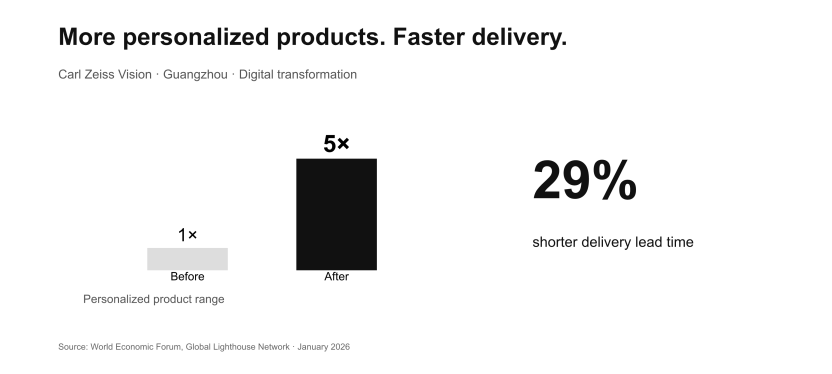
The factory could offer more choice and deliver it faster. That expands the market an operation can serve.
That is the ambition AI adoption should serve. It starts with what leadership wants the business to become and what prevents it from getting there today.
Much of what holds a company back is the distance between how its business works and what its software can support.
Manufacturers develop their own ways of working for good reasons. Their products, customers, equipment, and experience shape how they make decisions. Standard software handles the needs these businesses share, but leaves many of their particular requirements to the people using it.
Over time, employees become responsible for what the software cannot do. They connect systems, remember exceptions, and carry knowledge between departments. The arrangement can work for years. It becomes harder to sustain as the business grows more complex.
This is why custom software matters. It lets a company build its own operating knowledge into its systems, so more of the business can run without someone having to reconstruct the context each time. The company can keep standard products where they work well and build around the requirements they leave uncovered.
Until recently, many of these improvements were too specific to buy and too expensive to build. AI is changing that calculation. It can reduce the effort of developing software and help that software interpret information, such as documents and correspondence, that previously required a person to read.
More of the operation can now be supported by software built for it. Improvements that once required a large development budget can become practical, including changes the business has postponed for years.
That creates the foundation for AI to become useful across the company.
When AI use is left to individual employees, much of the work around it stays manual. Someone has to find the information, explain the situation, check the answer, and carry the result back into the business. Another employee may repeat the same work tomorrow.
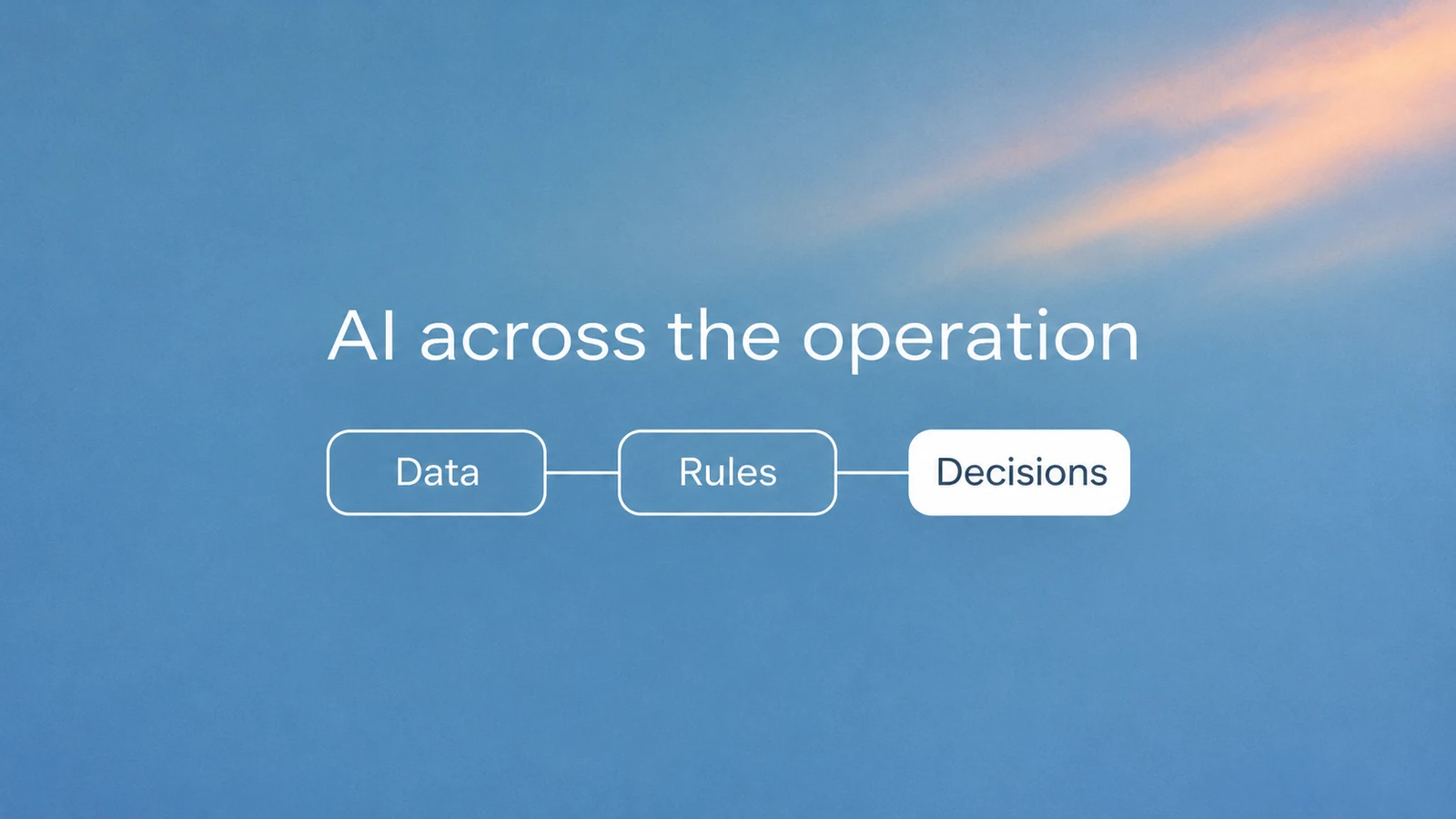
Integrating AI means building more of that context into shared systems. The company’s information, rules, and approval requirements become available where decisions are made. A useful result can reach the people and applications that need it.
This requires looking across the operation. A decision that improves one department’s numbers can make another department’s job harder. Reducing inventory can free up cash while making delivery less reliable. The software needs to account for how those decisions affect the business as a whole.
Schneider Electric’s El Paso site shows why those connections matter. Growing demand from data centres exposed bottlenecks across production, testing, and logistics. A transformation combining data engineering, integrated logistics, industrial IoT, and AI improved delivery and eliminated $43 million in backorders.[3]
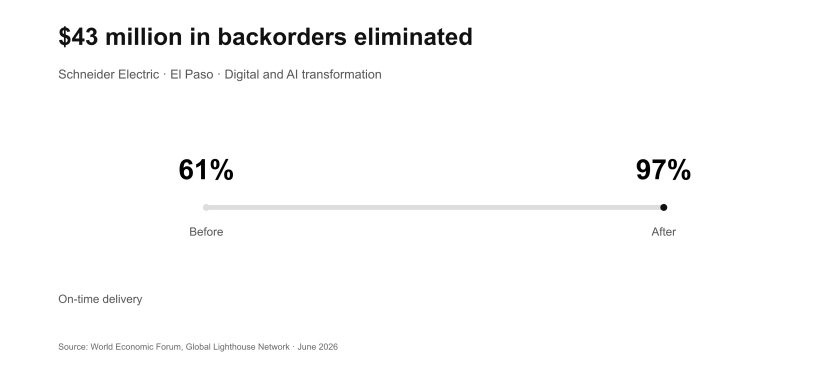
The business had demand it could not reliably fulfill. Coordinating the operation better helped it turn more of that demand into delivered orders.
A company can start with one application while working toward that larger goal.
The first project should remove a real limit on the business and produce a result worth measuring. It should also leave behind something the next project can use. Connected information, shared business rules, and experience putting AI into use should carry forward.
Without that continuity, a company can spend years buying tools and commissioning applications while remaining dependent on the same manual coordination. Each department gets new software, but the company still struggles to work as one business.
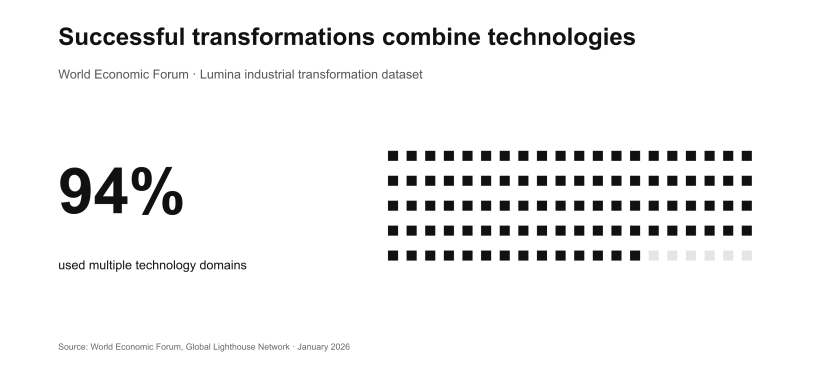
This broader approach also appears in the World Economic Forum’s research on successful industrial transformations. In its Lumina dataset, 94% combined multiple technology domains, with AI most often used alongside IoT, cloud, and digital twins.[1]
Building this capability requires a team that learns how the company works and stays involved as the software is put into use. At Reflex, our engineers work alongside the people running the business, connecting immediate projects to the broader changes the company wants to make.
This is also why waiting has a cost. Companies that start now can accumulate better information, reusable software, and experience changing their operations. Each improvement can make the next one easier.
A business that keeps AI confined to individual employees misses much of that compounding benefit. Its people may become more productive, while its ability to grow remains tied to an operating model built for an earlier stage of the company.
This is how the performance gap can widen. Each project adds to the company’s ability to change, so growth depends less on asking the same people to manage more complexity.
Sources
- World Economic Forum: New Lighthouse Sites and Lumina, January 2026. Zeiss Guangzhou results from a broader digital transformation and the finding on combined technology domains in the Lumina dataset.
- xSeriCon customer story. Background research on custom software. The company estimates it could save at least 10% of workshop time, with external client studies still needed to validate the estimate. The application was built without AI coding tools.
- World Economic Forum: AI in Manufacturing and Supply Chains, June 2026. Schneider Electric El Paso results from its combined digital and AI transformation.