Choosing between Reflex, Retool, and Superblocks for internal tools comes down to a few questions that matter more over time than they do on day one: who owns the application code, how much can you customize it, and where can you deploy it? All three tools let teams build internal apps faster than writing from scratch. Retool is a proven choice for teams that need standard CRUD apps and dashboards up fast, backed by 100+ pre-built components and native integrations with PostgreSQL, Snowflake, REST APIs, and Google Sheets. Superblocks is a strong fit for JavaScript and TypeScript teams who want AI-generated React code that stays in sync with their IDE. Reflex is built for Python teams who need full code ownership, 60+ built-in components, and deployment to cloud, VPC, or on-prem. In this guide, we compare all three across code ownership, customization, deployment, and AI-powered generation, including Reflex, the framework we build. We think Reflex is the right choice for most Python teams, but we've laid out the tradeoffs so you can decide for yourself.
TLDR:
- Retool: fastest path to a standard CRUD app or dashboard with a large pre-built component library, but app logic lives in JSON configs tied to their proprietary runtime and migrations are closer to rebuilds
- Superblocks: strong fit for JavaScript/TypeScript teams; Clark AI generates readable React code that syncs with your IDE, but apps run inside Superblocks' runtime so moving off requires partial rebuilds
- Reflex: Apache 2.0 Python files in your own Git repo, 60+ built-in components, wraps any React/npm component without writing JavaScript, and deploys to cloud, VPC, or on-prem via Helm with no proprietary runtime
- All three have AI generation: Retool outputs visual components in its own format, Superblocks' Clark AI produces React code that syncs with your IDE, and Reflex's AI Builder uses Claude Opus 4.6 to output standard Python your team owns
- Pick based on your team's primary language, how much deployment flexibility you need, and whether long-term code ownership matters
What is Retool?
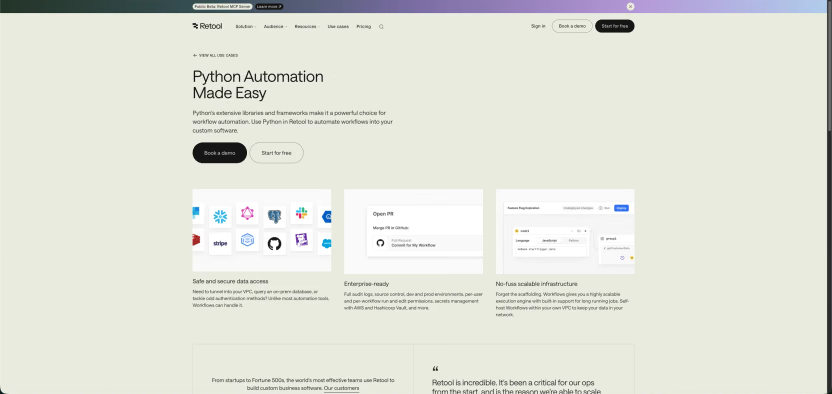
Retool is a proprietary low-code tool for internal applications like admin panels, dashboards, and workflow automations. It ships with a large library of pre-built UI components and native integrations with a wide range of data sources, including PostgreSQL, MySQL, MongoDB, Snowflake, Google Sheets, and REST APIs.
The core workflow is drag-and-drop: you place components on a canvas, wire them to queries, and add logic through a visual interface. For teams that need a standard CRUD app or a quick dashboard on top of existing databases, this approach delivers real speed, though a few trade-offs are worth weighing.
That speed does come with trade-offs worth weighing. Retool is a closed-source, hosted product. Application logic lives inside their proprietary runtime, and apps are stored as JSON configuration files tied to that runtime. Self-hosting requires an Enterprise plan and additional DevOps work to manage Docker or Kubernetes clusters. For teams that want delivery speed over long-term portability and are comfortable with a hosted model, these trade-offs are often worth it: Retool's depth of native integrations and battle-tested component library are genuinely hard to match.
What is Superblocks?
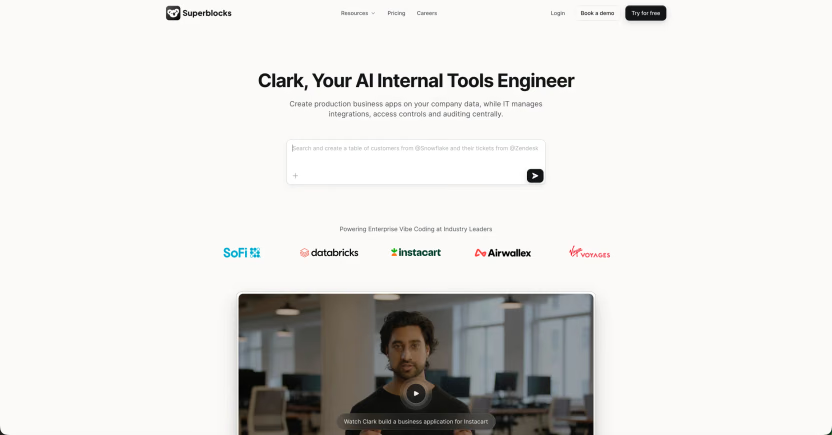
Superblocks positions itself as an AI-native internal tools builder aimed at engineering teams. Its headline feature is Clark, an AI agent that generates internal applications and automations from natural language prompts. You describe what you want, and Clark produces React code connected to your company's data sources and design systems.
Unlike Retool's drag-and-drop canvas, Superblocks leans into code generation. The apps it builds connect to databases, APIs, and third-party services, and the generated React code is readable and traceable. For teams already comfortable with JavaScript and TypeScript, this can feel more natural than a purely visual builder.
For JavaScript and TypeScript teams who want AI-generated code that syncs with their IDE and integrates with existing design systems, Superblocks is a strong fit. The generated code is readable and traceable, and Clark's governance features make it well-suited for organizations with strict design standards and complex business logic baked into JavaScript workflows. The trade-off is that apps run inside their runtime and component abstractions, so teams that are Python-first or need full control over deployment infrastructure should factor that dependency into their evaluation.
What is Reflex?
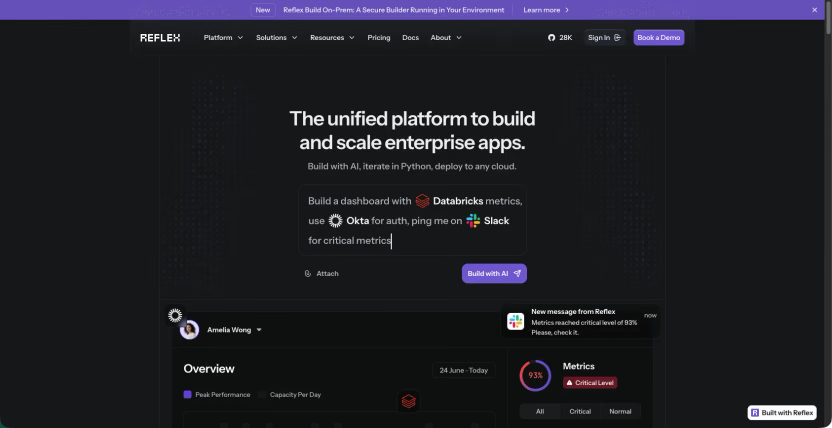
Reflex is an open-source, full-stack Python framework for building web applications without writing a single line of JavaScript. Both frontend and backend live in the same Python codebase, which means your data scientists, ML engineers, and backend developers can ship production internal tools without learning React or TypeScript. The framework ships with 60+ built-in components, a built-in ORM, and state management that syncs frontend and backend automatically over WebSockets.
The framework is Apache 2.0 licensed, with 28,000+ GitHub stars and adoption across 40% of Fortune 500 companies. You install it with pip install reflex, initialize a project with reflex init, and launch with reflex run. Teams use Reflex for admin panels, internal dashboards, RAG-powered chat tools, ML model interfaces, and multi-step workflow automation, all in pure Python.
Where Retool and Superblocks generate code inside proprietary runtimes, Reflex outputs standard Python you own completely. Every component, state handler, and route is readable code sitting in your repository. Our AI-powered builder at build.reflex.dev takes this further: describe an application in natural language, and it generates a full-stack Reflex app using Claude Opus 4.6, which supports a one million token context window for reasoning over large, complex codebases. The output is the same Python your team would write by hand, ready to debug, extend, and deploy anywhere.
Reflex vs Retool vs Superblocks: Feature-by-Feature Breakdown
The table below breaks down how Reflex, Retool, and Superblocks compare across the six factors that matter most when choosing an internal tools builder. Use it as a quick reference alongside the detailed sections below.
| Feature | Reflex | Retool | Superblocks |
|---|---|---|---|
| Code Ownership | Standard Python files (Apache 2.0); no proprietary runtime | JSON configs tied to Retool runtime; not portable | Readable React code; runtime dependency remains |
| Primary Language | Python (full-stack) | Visual/no-code + JavaScript transformers | React/TypeScript with Python backend |
| Migration Path | Zero exit cost from day one with standard Python files running on any Python-compatible infrastructure | Often closer to a rebuild than a migration; business logic and UI are tightly coupled to the proprietary runtime | React code depends on Superblocks runtime requiring partial rebuild to move elsewhere |
| Customization | Wrap any React component from npm without writing JavaScript, extend with any PyPI library using standard Python classes | Limited to component ecosystem with JavaScript transformers hitting hard limits on custom visuals | Code-level React access with Python backend support bounded by architectural constraints |
| Deployment Options | Cloud, VPC, or full on-prem | Cloud-hosted; self-hosting on Enterprise with DevOps overhead | Managed builder; on-prem agents in VPC |
| AI Code Generation | Full-stack Python via Claude Opus 4.6; output is hand-writable code | Visual components in Retool's format; no-code friendly | Traceable React code; syncs with IDE |
Code Ownership and Vendor Lock-In
Retool is built for speed. Teams can wire up a CRUD app or dashboard in hours, and the component library covers most standard patterns out of the box. The trade-off is portability: migrations are often closer to a rebuild because business logic and UI are tightly coupled to the platform.
Superblocks generates readable, traceable React code that engineers can sync with their IDE, which is a real advantage for JavaScript teams. The code still depends on Superblocks' runtime and component abstractions, so moving off the platform requires partial rebuilds instead of a clean lift-and-shift.
Reflex takes a different approach. Your apps are standard Python files, Apache 2.0 licensed, living in your Git repository. There's no proprietary runtime wrapping your logic. Run them on any Python-compatible infrastructure, modify them with any editor, and deploy them wherever your compliance team allows. The generated Python is identical to hand-written code, so your exit cost is zero on day one.
Customization and Extensibility
Retool's component ecosystem covers common internal tool patterns: tables, forms, charts, modals, and multi-step workflows. For teams building CRUD apps and dashboards, the built-in library handles most standard use cases. You can add JavaScript transformers, conditional formatting, and validation rules to handle most business logic. Where it hits limits is highly custom visuals or complex user flows that fall outside the catalog.
Superblocks gives engineering teams real code-level React access alongside Python support for backend logic. For JavaScript teams who want to write custom components or hook into existing design systems, that flexibility is meaningful and productive within their ecosystem.
Reflex lets you wrap any React component from npm without writing JavaScript. That means libraries like AG Grid, Framer Motion, or Spline drop straight into your Python codebase as typed components. You extend app logic using standard Python classes and any PyPI library, so the customization ceiling is the Python and React ecosystems combined, not a vendor's component catalog.
Deployment Options and Enterprise Security
Retool's self-hosting requires an Enterprise tier and hands-on DevOps to manage Docker or Kubernetes clusters, with feature updates lagging behind the cloud version. For teams without dedicated infrastructure support, that overhead can slow down iteration and add ongoing maintenance burden.
Superblocks takes a hybrid approach: on-premises agents run inside your VPC (AWS Fargate, Google Cloud Run, Kubernetes), keeping data local while the builder stays managed. This works well for organizations that need data residency compliance but are comfortable relying on Superblocks to manage the builder layer.
Reflex gives you the widest range of deployment options. Deploy with a single command, isolate within a VPC, or run on-prem with Helm chart orchestration. RBAC, audit logging, OIDC/SSO integration, and compliance-ready infrastructure ship out of the box. For teams in finance, healthcare, or government, Reflex removes the forced choice between development speed and deployment control.
AI-Powered Application Generation
Retool's AI Assist lets you describe an app and generates pages, queries, and components within its visual builder. For teams that prefer a visual, no-code workflow, it delivers a working first draft on the canvas in minutes with no code required. The output lives in Retool's format, so you refine it through their drag-and-drop interface instead of a code editor, which is exactly the workflow many non-engineering teams prefer.
Superblocks' Clark AI goes further, generating full-stack React applications that adhere to your organization's security and design standards. The generated code is traceable and syncs with your IDE. If your team thinks in JavaScript, Clark feels productive.
Reflex's AI Builder generates complete Python applications from a prompt. The output here is framework-based Python using Reflex's state management and component patterns, so every generated app follows the same architectural conventions your team already uses. Commit it, review it, deploy it like any other codebase.
When to Choose Each Tool
Retool excels at rapid internal tool assembly with its component library and integrations. If your team needs a standard CRUD app or a quick dashboard on top of existing databases and accepts hosted-tool dependency as a tradeoff, Retool delivers speed on day one.
Superblocks fits teams that already work in React and TypeScript and want AI-generated code that syncs with their IDE. Clark's governance features make it a good match for organizations with strict design systems and complex business logic baked into JavaScript workflows.
Reflex is the stronger fit when your team writes Python and needs to own the output long-term. The AI Builder generates full-stack apps as fast as either competitor, but the result is standard Python sitting in your repository, with no proprietary runtime wrapping the logic. For data science teams, ML engineers, and backend developers who need to read and debug production code without frontend expertise, that distinction matters more over time than it does on day one.
Final Thoughts on Internal Tool Development
All three tools solve the same core problem: building internal applications faster than writing from scratch. But they make different tradeoffs. Retool focuses on speed of assembly with a large component library and native integrations, at the cost of portability. Superblocks targets engineering teams already working in React, offering AI-generated code that stays within a managed runtime. Reflex trades the vendor-managed model for full code ownership, letting Python teams build, extend, and deploy applications without adopting a proprietary runtime. The right choice depends on your team's language preference, how much deployment flexibility you need, and how important long-term portability is for the tools you're building.
Written by

FAQ
How do I decide between Reflex, Retool, and Superblocks for my team's internal tools?
Your decision depends on three factors: who will maintain the applications long-term, whether you need deployment flexibility, and how much customization your use cases require. Choose Reflex if your team writes Python and needs full code ownership with any deployment option. Choose Retool if you need the fastest path to a standard CRUD app and accept vendor dependency. Choose Superblocks if your team already works in React/TypeScript and needs AI-generated code within a managed platform.
What happens to my applications if I need to migrate away from each platform?
Retool's JSON configs only run inside their proprietary runtime, so leaving means rebuilding. Superblocks' React code depends on their runtime, requiring a partial rebuild. Reflex outputs Apache 2.0 Python files that run on any Python-compatible infrastructure, so your exit cost is zero from day one.
Which tool is best for Python-first teams building AI-powered internal applications?
Reflex is purpose-built for Python teams building AI applications. You can integrate any PyPI library, wrap React components without writing JavaScript, and generate complete applications using our AI Builder at build.reflex.dev with Claude Opus 4.6. The framework includes production-ready patterns for chat interfaces with streaming responses, RAG implementations, and custom ML model integration using PyTorch, all in pure Python code your data scientists and ML engineers can read and maintain.
Can I deploy these tools on-premises or in my own cloud infrastructure?
Retool requires an Enterprise tier for self-hosting and lags behind their cloud version for feature updates. Superblocks uses on-premises agents in your VPC while keeping the builder managed. Reflex provides the widest deployment options: single-command cloud deployment (reflex deploy), one-click deployment to GCP/AWS/Azure on Enterprise plans, VPC isolation, or full on-premises deployment with Helm chart orchestration, all with the same codebase and feature set.
How does AI-generated code differ between these three platforms?
Retool's AI generates components within their visual builder, locked in proprietary format. Superblocks' Clark AI generates React code tied to their runtime and component abstractions. Reflex's AI Builder generates framework-based Python using standard state management patterns; the output is identical to hand-written Reflex code, follows your team's architectural conventions, and commits to Git like any other codebase you own.