What Are the Best Full-Stack Web App Frameworks in 2026?
Compare the best full-stack web app frameworks in May 2026. See how Reflex, Laravel, Rails, Next.js, and Django handle auth, ORM, and real-time features.
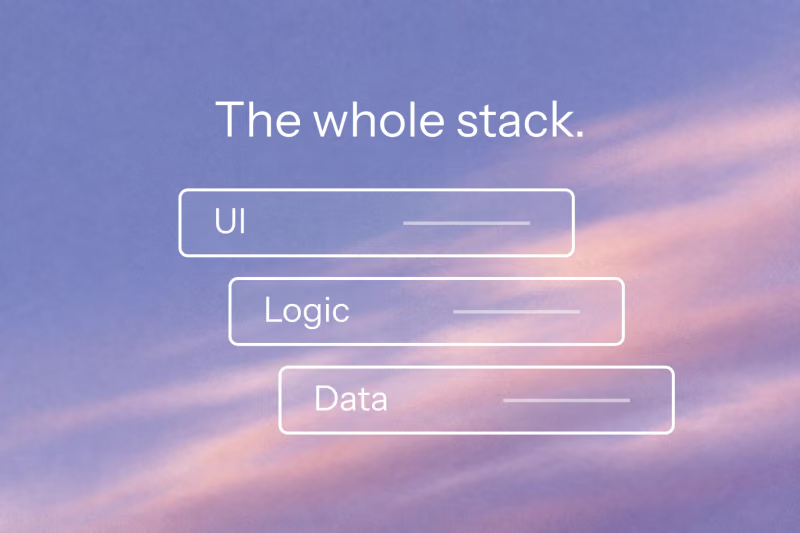
If you're comparing full-stack frameworks in 2026, the options are good and genuinely different. Laravel, Rails, Django, Next.js, and Reflex each solve real problems well, but make different tradeoffs around language consistency, built-in features, and how much assembly you own. We looked at all five across development speed, AI agent compatibility, deployment options, and more to give you a clearer picture of where each one fits.
TLDR:
- Full-stack frameworks bundle frontend, backend, database, and auth: the difference is how much each one covers vs. how much you wire yourself
- Laravel and Rails are mature picks for PHP and Ruby teams building SaaS products and APIs
- Next.js is the default for React teams that need SSR and SEO
- Django is a batteries-included Python backend with a deep ecosystem for data-heavy apps
- Reflex covers frontend, backend, auth, ORM, and real-time sync in pure Python, and is worth a look if language consistency or AI agent compatibility matters
The 2026 Full-Stack Framework Overview
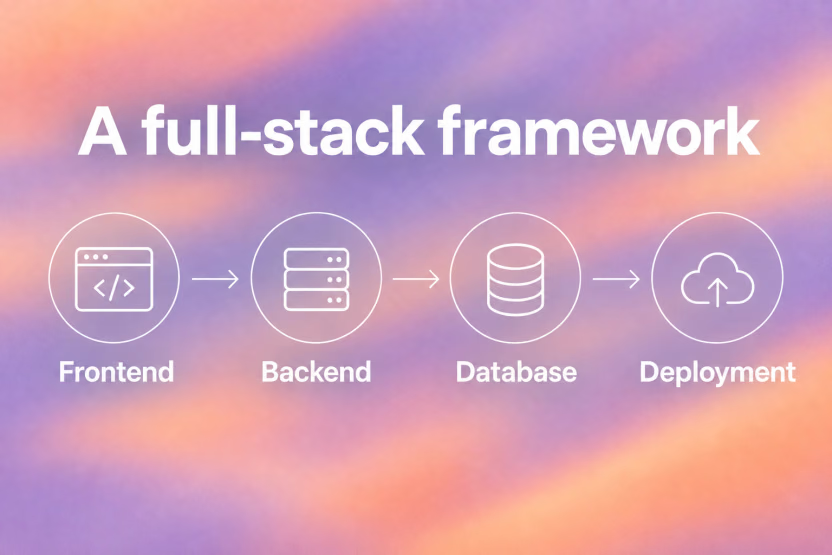
The framework question has gotten more interesting. In 2026, teams are choosing between languages and output strategies, while also weighing how much JavaScript they want to manage, how much built-in tooling they need out of the box, and how their stack performs when AI agents are generating a growing share of the code.
Mature frameworks like Laravel, Rails, and Django bring years of production battle-testing, deep ecosystems, and large talent pools. That stability is worth a lot for teams building SaaS products, APIs, or data-heavy applications where predictability matters more than novelty. Next.js is the default for React teams who need server-side HTML generation and a rich frontend ecosystem without giving up the component model they already know.
Newer frameworks like Reflex (built by us) are optimized for a different set of constraints: single-language codebases, AI agent compatibility, and shipping full-stack UIs without splitting a team across Python and JavaScript. Neither direction is universally better. The right framework fits your team's skills and the tradeoffs you're willing to own.
How We Compared the Best Full-Stack Web App Frameworks in 2026
Picking a framework is one thing. Picking the right one for where the industry is headed is another. Here's what we weighted when putting this list together:
- Development speed: How quickly can you go from idea to deployed app? We looked at scaffolding, hot reload, and time to first deploy.
- Built-in features: Are auth, database connections, and real-time capabilities included out of the box, or bolted on after the fact?
- AI coding assistant compatibility: How well does the framework work with agents like Claude Opus 4.6 or GPT-5.4? ProjDevBench (arXiv, Feb 2026) found a 27.38% acceptance rate across end-to-end repo generation tasks, with "specification alignment" (keeping data contracts consistent across files) as the top failure mode. Frameworks with structured, opinionated APIs produce fewer cross-boundary mismatches than loosely organized ones.
- Enterprise deployment options: Can you self-host, deploy to a VPC, or run on-prem for compliance-sensitive industries?
- Community and ecosystem health: GitHub stars, contributor activity, documentation quality, and real production usage by recognized companies all factored in.
Next.js
React SSR with Rich Ecosystem
Next.js is a React framework that layers server-side HTML generation, static generation, and backend API routes onto React's component model. For teams already deep in the React ecosystem who need SEO-friendly pages with fast initial loads, it's a natural fit.
What Next.js Offers
- File-system routing: Parameterized routes, automatic code splitting, and page prefetching with hot-module replacement out of the box
- Output flexibility: SSR, static generation, ISR, and integrated API routes all live in a single project structure
- Full-stack runtime: React component UI paired with Node.js and Edge runtimes for frontend and backend under one roof
- Rich ecosystem: Massive library of React components, third-party integrations, and community support
- Production trust: Used by major enterprise brands
It's a strong pick for public-facing websites where SEO and server-generated output are non-negotiable.
The flexibility is by design, and for many teams it's the right call. Next.js lets you choose your database, auth provider, and state management approach, so teams that have strong opinions on those layers get a best-in-class React experience with SSR and one of the largest ecosystems in web development. One concrete advantage that carries through the whole stack: because Next.js stays in TypeScript throughout, teams get compile-time type safety from database schema to server logic to UI components. Where the flexibility adds friction is for smaller teams where wiring up the full stack from scratch delays getting to a working app. The client/server state split also means AI coding agents must reason across that boundary, which can produce less consistent generated code than frameworks with a unified state model.
One deployment consideration worth knowing: several of Next.js's marquee features (Incremental Static Regeneration, the built-in Image Optimization component, and Edge Middleware) work best on Vercel's own infrastructure. Self-hosting on AWS, GCP, or a bare VPS is supported, but some of those capabilities require additional configuration or third-party alternatives. Teams planning to self-host should verify which features they rely on before committing.
Vibe Coding with Next.js
Next.js has massive training data coverage, so agents like Claude Opus 4.6 and GPT-5.4 generate React components and API routes confidently. The catch: agents must still pick and wire auth, an ORM, and a real-time layer themselves, which multiplies decision points. The client/server execution boundary is also a common source of field-name mismatches in generated full-stack code.
Django
Batteries-Included Python Backend Framework
Django is Python's heavyweight, carrying roughly 87,500 GitHub stars, long-term support releases, and years of production battle-testing across industries. Because Python sits at the center of AI and data science, Django benefits from that ecosystem gravity in ways PHP and Ruby frameworks can't match.
What Django Offers
- Built-in ORM: Pythonic database layer with migrations that keep schema changes trackable across environments
- Batteries included: Auth, admin interface, form handling, CSRF protection, and session management all ship ready to use
- Rich ecosystem: Stable third-party libraries like Django REST Framework, Celery, and django-allauth cover most backend needs out of the box
- Python-native: Sits at the center of the AI and data science ecosystem, giving you direct access to ML libraries without extra glue
- Production-proven: Has powered high-traffic workloads at Instagram, Mozilla, and the Washington Post
For teams that want proven Python maturity and Django's deep ecosystem for complex business applications, it's a reliable choice with a large talent pool.
Django's templating handles server-generated HTML well. For interactive dashboards or real-time features, the standard path is pairing Django with React or Vue over REST or GraphQL: a well-understood split where Django owns business logic and auth while JavaScript owns the UI. Teams with dedicated frontend developers often find this works smoothly, and the separation of concerns can be an advantage for larger organizations with specialized roles.
The tradeoff to weigh: adding a full JavaScript frontend does increase the number of moving parts (build tooling, state management, API contracts), which can slow down smaller teams or projects where a single developer owns the full stack.
Vibe Coding with Django
Django's conventional file layout (models.py, views.py, urls.py) is well-represented in agent training data, so Copilot and Cursor generate boilerplate reliably. The friction point is the JavaScript boundary: once a React SPA enters the picture, agents must coordinate the snake_case-to-camelCase serializer gap, a common source of silent runtime failures in generated full-stack code.
Ruby on Rails
Convention-Driven, Fast Startup Framework
Rails pioneered "convention over configuration," giving teams an opinionated MVC architecture where naming a model User automatically maps it to a users table, routes to /users, and so on. That predictability is exactly why startups reach for it when speed to launch matters most.
What Rails Offers
- Active Record ORM: Intuitive database interactions with trackable, reversible migrations across environments
- Hotwire (Turbo + Stimulus): Real-time interactivity without heavy JavaScript bundles
- Built-in auth and jobs: Authentication generator, Solid Queue for background jobs, and production-ready caching out of the box
- Convention over configuration: Opinionated MVC architecture that maps models, routes, and tables automatically — less boilerplate, faster builds
- Production trust: Trusted by Shopify, GitHub, Basecamp, and Airbnb, with over 7,000 contributors
For startups building MVPs, Rails' rich ecosystem and strong conventions translate directly into faster launches without sacrificing scalability.
Pairing Rails with React via Inertia or running it in API mode is a well-understood pattern with a large community behind it. For many teams, especially those with dedicated frontend developers, that separation is a feature, not a limitation: each layer can be tested, deployed, and scaled independently. Teams that want real-time features beyond Hotwire can reach for Action Cable, which is mature and production-proven. Where the split adds friction is for smaller teams or solo developers where context across Ruby and JavaScript boundaries slows things down, or for projects where AI coding agents need to reason across both languages at once.
Vibe Coding with Ruby on Rails
Rails' strict naming conventions give agents like Claude Opus 4.6 a predictable surface: name a model Order and the agent knows the table is orders, the route is /orders, and the controller is OrdersController. The friction point arrives when a JavaScript frontend enters the picture — agents must coordinate across two languages, and cross-boundary state mismatches are the most common failure mode in generated full-stack Rails code.
Laravel
SaaS-ready Backend, Proven at Scale
Laravel remains one of the most battle-tested PHP frameworks available, and for good reason. Its ecosystem covers nearly every backend concern you'll encounter: Eloquent ORM for expressive database queries, Blade templating for server-rendered HTML, and a unified auth layer through Passport and Sanctum that handles SPAs, mobile apps, and API tokens alike.
What Laravel Offers
- Eloquent ORM: Expressive database layer with clean, readable syntax for queries, relationships, and migrations
- Blade Templating: Server-rendered HTML with interactive content, layouts, and reusable components built in
- Built-in Auth: Passport and Sanctum cover SPAs, mobile apps, and API tokens without third-party auth services
- Caching & Job Queues: Native caching drivers, queue system, and Horizon for a clear path as traffic grows
- Inertia.js Integration: Pair Laravel with React or Vue frontends while keeping all routing on the server
If your team is already invested in PHP and building SaaS products or agency projects, Laravel gives you a proven foundation with solutions for nearly every server-side problem.
One tradeoff worth knowing: Laravel is a backend-first framework. Building interactive UIs means pairing it with React, Vue, or another JavaScript library. For teams with dedicated frontend developers alongside PHP expertise, that split is a familiar and well-understood architecture, and Laravel handles its side of it very well. The separation of concerns can also be an advantage for larger organizations with specialized roles, where each layer can be tested, deployed, and scaled independently. Where the split adds friction is for smaller teams or solo developers where context across the PHP-to-JavaScript boundary slows things down, or for projects where AI coding agents need to reason across both languages at once.
Vibe Coding with Laravel
Laravel's Artisan commands (php artisan make:model, make:controller) are well-covered in agent training data, so Copilot and Cursor generate scaffolds reliably. The friction point is the PHP-to-JavaScript boundary: once Inertia or a separate SPA enters the picture, agents must coordinate across two languages, and cross-boundary field mismatches are the most common failure mode in generated full-stack Laravel code.
Reflex
Full-Stack Python, Zero JavaScript
We built Reflex because a specific gap kept coming up: Python teams (data scientists, ML engineers, backend developers) had no clean path to shipping production-quality web UIs without crossing into JavaScript. Streamlit and Dash covered quick prototypes, but hit walls on layout flexibility, real-time features, and auth. Django, Rails, and Laravel all require a separate JavaScript frontend, which means a second language, a second build system, and a split codebase. For teams where every engineer knows Python and nobody specializes in React, that split is a genuine bottleneck. We built Reflex to close it: one language, one codebase, frontend and backend together, without giving up the production features that make a real app.
Reflex is an open source, full-stack Python framework that compiles to a FastAPI backend and a React frontend. You write everything in Python: no JavaScript, no separate frontend repo, no context switching. That makes it a strong fit for Python teams who want to ship production apps without splitting their codebase across two languages.
What Reflex Offers
- Built-in UI components: 60+ components with theming, dark mode, and full styling control out of the box
- Auth and ORM: Provider-based auth (Clerk, Google, Okta, Azure) and a built-in database ORM with single-line external connections
- Real-time state sync: WebSocket-based state sync and background jobs with no separate real-time layer required
- AI app builder: Generates complete apps from natural language prompts at build.reflex.dev
- Single-command deployment:
reflex deployships your app to AWS, GCP, or Azure in one step, with on-prem and VPC options for compliance-sensitive industries
The tradeoff is that Reflex is a newer framework with a smaller ecosystem than Laravel, Rails, or Django. If your team is already fluent in one of those, the switching cost is real. Where Reflex earns its place is when language consistency across the full stack matters: data science teams, ML engineers, and Python shops who want to ship UIs without hiring frontend specialists.
Vibe Coding with Reflex
Reflex is purpose-built for agent-driven development. All state, event handlers, and UI components live in a single Python file, so agents like Claude Opus 4.6 never have to coordinate across a language boundary. The MCP server exposes a structured component and event API, giving agents a clean surface to read and write full-stack features in one pass with no client/server split to navigate.
Feature Comparison: Full-Stack Frameworks in 2026
Backend Capabilities
The sharpest practical difference is how much backend infrastructure ships out of the box versus how much you wire yourself. Laravel, Rails, Django, and Reflex all bundle auth, an ORM, and background jobs to varying degrees. Next.js is the outlier: none of the three ship by default, which gives you full flexibility but means more assembly before your first feature lands. Django's background job story also requires a separate message broker (Celery, RQ, or Dramatiq), adding infrastructure the other frameworks avoid.
| Capability | Next.js | Django | Ruby on Rails | Laravel | Reflex |
|---|---|---|---|---|---|
| Built-in Authentication | Auth.js (NextAuth): install separately; ~60–100 lines for route handler, adapter, and provider config | django.contrib.auth: session auth, permissions, and groups built-in; social auth via django-allauth (~10–15 settings lines) | rails generate authentication: one command generates User model, session controller, and password reset flow | Passport (full OAuth2 server) + Sanctum (SPA/API tokens); Sanctum setup is ~15–20 lines of config | Clerk, Google, Okta, or Azure via Python provider config; ~5–10 lines; no vendor lock-in |
| Built-in ORM | No built-in ORM; teams choose Prisma, Drizzle ORM, or Sequelize and configure separately | Django ORM: model classes map to DB tables with auto-generated migrations; supports PostgreSQL, MySQL, SQLite, and Oracle | Active Record: model naming conventions auto-map to tables; reversible migrations with rails db:migrate | Eloquent ORM: fluent query builder, model relationships (hasMany, belongsTo), and schema migrations via Artisan CLI | SQLModel-based ORM: single-line external DB connections for PostgreSQL, MySQL, or SQLite; schema migrations built-in |
| Background Jobs | No native queue; wire BullMQ (Redis-backed) or define Vercel Cron Jobs via cron syntax in vercel.json | Django Tasks framework (built-in since 6.0); requires a separate worker process via the django-tasks-worker package | Active Job + Solid Queue: database-backed job queue, no Redis required by default; ships with Rails 8 | Laravel Queues (Redis, SQS, or database-backed) + Horizon dashboard for real-time queue monitoring | @rx.background_task decorator: async jobs run server-side with state updates streamed back via yield |
Frontend & Real-Time
Laravel, Rails, and Django all started from a server-generated HTML model, with real-time behavior layered on top, each requiring its own additional setup to reach WebSocket support. Next.js gives you a full React component model but real-time still means picking and wiring a third-party library. Reflex takes a different approach: all UI state lives on the backend, and every user interaction triggers an event pushed back to the client over a persistent WebSocket automatically. There is no separate real-time layer; state sync is the default.
| Capability | Next.js | Django | Ruby on Rails | Laravel | Reflex |
|---|---|---|---|---|---|
| Built-in UI Components | No built-in components; teams bring their own library — shadcn/ui, Radix UI, MUI, or Chakra are common choices | No component system; Django Templates render server-side HTML; can attach React or Vue as a separate SPA over REST | No JavaScript component library by default; Hotwire (Turbo + Stimulus) handles page updates without full component abstraction | Blade UI Kit and the official Flux component library provide pre-built components; Livewire adds reactive behavior server-side | 60+ built-in Radix UI-based components (Button, Form, Table, Chart, Modal, etc.) with unified theming and dark mode, no third-party install needed |
| Real-Time WebSocket Support | No built-in WebSocket layer; teams wire Pusher, Ably, or socket.io as separate hosted or self-managed services | Django Channels (separate pip install) adds WebSocket support via ASGI; requires a Redis channel layer for multi-process deployments | Action Cable ships with Rails; uses an in-process adapter for single-server and Redis pub/sub for multi-server deployments | Laravel Reverb (self-hosted WebSocket server, ships with Laravel 11+) paired with the Echo client library handles real-time events | All state changes are pushed to the browser over a persistent WebSocket connection by default; no channel library, broker, or extra config required |
Deployment Options
All five frameworks support self-hosting, but first-party deployment tooling varies sharply. Next.js is tightly optimized for Vercel; teams self-hosting on AWS or GCP need to rebuild edge caching and ISR themselves. Django has no single-command deploy path in core at all. Rails, Laravel, and Reflex each ship first-party CLI tooling, with Reflex's handling containerization, provisioning, and multi-region rollout in one step, plus VPC and on-prem options for compliance-sensitive industries.
| Capability | Next.js | Django | Ruby on Rails | Laravel | Reflex |
|---|---|---|---|---|---|
| Single-Command Deployment | vercel CLI pushes to Vercel's edge network with ISR and Image Optimization enabled by default; self-hosting requires next build + next start with a manually configured Docker setup | No first-party deploy CLI; standard path is Gunicorn or Uvicorn behind Nginx, configured manually or via Fabric/Ansible scripts; platform-as-a-service options include Railway and Render | kamal deploy (Kamal 2) builds a Docker image and deploys it to any SSH-accessible server (Hetzner, DigitalOcean, bare metal) with zero-downtime rollover via a Traefik proxy | Laravel Cloud handles managed deployment via dashboard or CLI; Forge provisions and configures servers on AWS, DigitalOcean, Vultr, or Hetzner; Envoyer adds zero-downtime releases on top of either | reflex deploy containerizes the app, and provides a single command to deploy to AWS, GCP, or Azure for users on the enterprise plan; no Dockerfile required |
| On-Premises / VPC Deployment | next build outputs a standalone Docker image; ISR and Edge Middleware require self-managed cache and CDN (e.g., Cloudflare Workers) to replicate Vercel-native behavior | Runs on any WSGI/ASGI-compatible server (Gunicorn, Uvicorn, Daphne) behind Nginx; deployable to Kubernetes via standard Docker containers with no framework-specific constraints | Kamal 2 deploys Docker containers to any server you control; Solid Queue and Solid Cache ship with Rails 8, removing the Redis dependency for simpler self-hosted stacks | Forge provisions servers on any major cloud provider or bare metal; full application stack (PHP-FPM, Nginx, queue workers, scheduler) configured and managed through Forge's dashboard | Deploy apps to a VPC or on-premises infrastructure on the enterprise plan; Helm chart orchestration for Kubernetes and GitOps pipelines |
AI Development
ProjDevBench (arXiv, Feb 2026) tested six coding agents on end-to-end repository generation and found a 27.38% acceptance rate, with "specification alignment" (keeping data contracts consistent across files) as the top failure mode. The split-stack version of this is concrete: a Django backend serializes user_id; the React frontend expects userId. Both are valid in their layer; the mismatch only surfaces at runtime.
No benchmark has directly isolated framework architecture as the variable, and teams using OpenAPI schemas or tRPC can close much of this gap, so the advantage is situational. Next.js stays in TypeScript throughout, which removes the language boundary, though agents still coordinate across the client/server execution split. Django, Rails, and Laravel add both a language boundary and a state boundary once a JavaScript frontend is involved. Reflex keeps all state and event handlers on the Python backend as a single tree, giving agents one surface to read and one set of handlers to call, with fewer coordination points for full-stack feature generation.
| Capability | Next.js | Django | Ruby on Rails | Laravel | Reflex |
|---|---|---|---|---|---|
| AI-Powered App Builder | No first-party builder; Vercel's v0.dev (separate product) generates React component scaffolds from prompts but does not produce a full Next.js app | No builder; conventional file layout (models.py, views.py, urls.py) is widely represented in Copilot and Cursor training data, improving raw generation quality | No builder; rails generate scaffolds follow strict naming conventions that agents reproduce reliably without extra prompting | No builder; Artisan commands (php artisan make:model, make:controller) pair predictably with Copilot and Cursor generation workflows | build.reflex.dev generates complete full-stack Python apps from natural language prompts; MCP server enables direct Claude Desktop integration for in-editor generation |
| AI Coding Agent Compatibility | TypeScript end-to-end removes the language boundary; agents still coordinate across the client/server execution split, which is the most common source of field-name mismatches in generated code | Python backend has deep training data coverage; when a React or Vue SPA is added, agents must coordinate across the snake_case (Django) to camelCase (JS) serializer boundary — a common runtime failure mode | Convention-driven naming (User model maps to users table maps to /users routes) gives agents a predictable surface; cross-language coordination becomes a factor when a JavaScript frontend is introduced alongside the Ruby backend | PHP is well-represented in agent training data; Eloquent relationships and Artisan scaffolds generate correctly in most cases; coordinating the PHP-to-JavaScript boundary when using Inertia or a separate SPA adds an extra reasoning step for agents | Single Python file holds state, event handlers, and UI components; MCP server exposes a structured component and event API; no cross-language boundary for agents to coordinate across when generating full-stack features |
Side-by-Side Summary: Full-Stack Frameworks in 2026
The tables above break down each category in detail. Here is the full picture in one view, with concrete examples for each decision factor rather than vague checkmarks.
| Factor | Next.js | Django | Ruby on Rails | Laravel | Reflex |
|---|---|---|---|---|---|
| Primary Language | TypeScript / JavaScript end-to-end; type safety from DB schema to UI component via tRPC or Prisma | Python backend; a separate JavaScript SPA is required for interactive UIs | Ruby backend; Hotwire covers basic interactivity, but a full React or Vue layer means two languages | PHP backend; Inertia.js or a separate SPA adds a JavaScript layer on top | Python throughout; no JavaScript file ever written, the frontend compiles from Python at build time |
| Auth Out of the Box | Auth.js installed separately; ~60–100 lines for route handler, adapter, and OAuth provider config | django.contrib.auth ships built-in; social login via django-allauth adds ~10–15 settings lines | rails generate authentication produces User model, session controller, and password reset in one command | Passport handles full OAuth2 server flows; Sanctum covers SPA tokens and mobile auth in ~15–20 config lines | Clerk, Google, Okta, or Azure wired in ~5–10 Python lines; no vendor lock-in, no separate auth service required |
| ORM & Migrations | No built-in ORM; teams pick Prisma, Drizzle, or Sequelize and run separate migration commands | Django ORM maps Python model classes to tables; makemigrations and migrate track schema changes across environments | Active Record auto-maps model names to table names; rails db:migrate applies reversible migrations | Eloquent provides fluent query builder and relationship helpers (hasMany, belongsTo); Artisan CLI runs migrations | SQLModel-based ORM; connect PostgreSQL, MySQL, or SQLite in one line; schema migrations built into the framework |
| Real-Time / WebSockets | No built-in layer; teams wire Pusher, Ably, or socket.io as separate hosted services with their own SDKs | Django Channels adds WebSocket support via ASGI; requires a Redis channel layer for multi-process production deployments | Action Cable ships with Rails; single-server mode uses in-process adapter, multi-server requires Redis pub/sub | Laravel Reverb (self-hosted WebSocket server, ships with Laravel 11+) paired with the Echo client library | All state changes push to the browser over a persistent WebSocket by default; no channel library, broker, or extra config |
| Built-in UI Components | No built-in components; shadcn/ui, Radix UI, or MUI installed separately per project | Server-side HTML templates only; React or Vue added as a separate SPA over REST for interactive UI | Hotwire (Turbo + Stimulus) handles page updates; no JavaScript component library ships by default | Blade UI Kit and the official Flux library cover common components; Livewire adds reactive server-side behavior | 60+ Radix UI-based components (Button, Form, Table, Chart, Modal, DataTable) with unified theming and dark mode built in |
| Background Jobs | No native queue; BullMQ (Redis-backed) or Vercel Cron Jobs configured via vercel.json cron syntax | Django Tasks (built-in since 6.0) runs jobs via a separate django-tasks-worker process; Celery still common for older projects | Active Job + Solid Queue (ships with Rails 8) runs database-backed jobs; no Redis required by default | Laravel Queues support Redis, SQS, or database backends; Horizon dashboard shows real-time queue throughput | @rx.background_task decorator runs async jobs server-side; state updates stream back to the browser via yield |
| Deployment Tooling | vercel CLI targets Vercel's edge network; self-hosting requires manual Docker setup and third-party CDN for ISR | No first-party deploy CLI; standard path is Gunicorn/Uvicorn behind Nginx, or a PaaS like Railway or Render | kamal deploy builds a Docker image and ships it to any SSH-accessible server with zero-downtime Traefik proxy | Laravel Cloud or Forge provisions servers on AWS, DigitalOcean, Vultr, or Hetzner; Envoyer adds zero-downtime releases | reflex deploy containerizes the app, and provides a single command to deploy to AWS, GCP, or Azure for users on the enterprise plan; no Dockerfile required |
| On-Prem / VPC Support | Standalone Docker image via next build; ISR and Edge Middleware need manual Cloudflare Workers setup to match Vercel behavior | Runs on any WSGI/ASGI server behind Nginx; standard Docker containers work on Kubernetes with no framework-specific constraints | Kamal 2 deploys to any server you control; Solid Queue and Solid Cache remove the Redis requirement for simpler self-hosted stacks | Forge provisions bare metal or any major cloud; manages PHP-FPM, Nginx, queue workers, and scheduler through a single dashboard | Deploy apps to a VPC or on-premises infrastructure on the enterprise plan; Helm chart orchestration for Kubernetes and GitOps pipelines |
| AI Agent Compatibility | TypeScript end-to-end removes the language boundary; agents still coordinate across the client/server execution split, the most common source of field-name mismatches | Python backend has deep training coverage; adding a React SPA forces agents to cross the snake_case-to-camelCase serializer boundary — a frequent runtime failure mode | Convention-driven naming gives agents a predictable surface; cross-language coordination becomes a factor when a JavaScript frontend is introduced | PHP well-represented in training data; Eloquent and Artisan scaffolds generate reliably, but coordinating the PHP-to-JavaScript boundary adds a reasoning step for agents | Single Python file holds state, event handlers, and UI; MCP server exposes a structured component and event API; no cross-language boundary for agents building full-stack features |
| Best Fit | React teams that need SSR, SEO, and end-to-end TypeScript type safety with the largest frontend ecosystem | Python teams building APIs, data-heavy applications, or projects that need ML library access without extra glue | Startups optimizing for fast MVP launches with a Ruby team and a preference for strong conventions over configuration | PHP teams building SaaS products, agency projects, or APIs where a battle-tested backend with comprehensive tooling matters | Python teams shipping production UIs without JavaScript, or codebases where AI agents write a growing share of features |
When Reflex Is the Right Choice
Laravel, Rails, Next.js, and Django are proven frameworks. If your team is fluent in PHP, Ruby, or JavaScript, staying in that ecosystem is often the fastest path to a working product.
Reflex earns its place when language consistency matters. For Python teams shipping production UIs without JavaScript expertise, or teams where AI agents write a growing share of code, a single-language codebase cuts context-switching and shrinks the surface area where things break. You can also point an LLM like Claude Sonnet 4.6 at a single Reflex file and get a working feature back, because there is no context switching between frontend and backend languages. State, event handlers, and UI all live in one Python file.
Every event handler runs on the backend as a Python function. The UI updates automatically when state changes: no API layer, no separate frontend repo, no JavaScript to maintain.
Add the AI builder at build.reflex.dev for generating complete apps from natural language, plus on-prem and VPC deployment for compliance-sensitive industries, and you have a stack that covers more of the full-stack surface in pure Python than any comparable option we found.
Final Thoughts on Selecting a Full-Stack Framework
The best framework for your team is the one that fits the skills you already have and the tradeoffs you're willing to own. Laravel, Rails, Django, and Next.js are all proven choices with strong ecosystems. If your team lives in Python and wants to ship production UIs without picking up JavaScript, or if AI agents are writing a growing share of your codebase, Reflex is worth a serious look. Give it a try at reflex.dev.
Written by

FAQ
Which full-stack framework should I choose if I'm building with AI coding agents?
Choose a framework with structured, opinionated APIs that agents can reason about consistently. Single-language frameworks like Reflex produce better AI-generated code because agents like Claude Opus 4.6 don't need to context-switch between Python and JavaScript, which reduces inconsistencies and iteration cycles.
How do I pick between Laravel, Rails, and Django for a backend-heavy project?
All three deliver solid backend tooling, so the decision comes down to ecosystem fit. Pick Laravel if your team knows PHP and you're building SaaS products, Rails if you're optimizing for startup speed with Ruby, or Django if you need Python's data science libraries and want proven stability at Instagram-level scale.
Can I build real-time collaborative features without learning JavaScript?
Yes, with Reflex. Traditional frameworks require layering WebSocket libraries on top of PHP, Ruby, or Python backends, then wiring them to React frontends. Reflex handles real-time state sync through WebSockets natively in pure Python, so features like live dashboards or chat interfaces work without crossing language boundaries.
What's the biggest practical difference between Next.js and full-stack Python frameworks?
Next.js ships routing and HTML generation but leaves auth, database, and background jobs as integration exercises. It also stays in TypeScript throughout, giving teams compile-time type safety from database schema to server logic to UI components, a concrete advantage over dynamically typed Python frameworks by default. Full-stack Python frameworks like Django or Reflex bundle backend capabilities out of the box, which cuts initial setup time, though you lose that zero-config type safety unless you add Pydantic v2 and type hints deliberately. Choose Next.js if you need React-specific features and end-to-end TypeScript type safety; choose a Python framework if your team lives in Python and wants batteries included.
When should I consider a single-language framework instead of mixing backend and frontend technologies?
When development speed matters more than library selection, when your team doesn't have dedicated frontend specialists, or when you're building internal tools where consistent patterns beat custom UI polish. Single-language frameworks reduce the coordination overhead that comes with managing changes across separate Python/Ruby/PHP backends and JavaScript frontends.