What 'Enterprise-Ready' Really Means for AI App Builders in March 2026
Learn what 'enterprise-ready' actually means for AI app builders in March 2026: security, compliance, deployment options, RBAC, and maintainable code requirements.
Tom Gotsman
Security questionnaires arrive before you get technical demos. Your InfoSec team blocks tools that can't run in your VPC. Compliance frameworks demand role-based access controls before you process real data. When you're choosing an enterprise ready AI app builder, the feature comparison comes second, because deployment restrictions, audit requirements, and code maintainability standards eliminate most options before your developers write a single line of code.
TLDR:
- Enterprise AI builders require on-premises deployment and VPC options to meet compliance rules in finance, healthcare, and government sectors.
- RBAC prevents unauthorized data access and cuts insider threat risks by enforcing role-based permissions in code.
- Readable Python code reduces maintenance costs by up to €250,000 annually compared to generated JavaScript applications.
- Framework-based approaches generate components that integrate with existing systems instead of standalone applications.
- Reflex outputs maintainable Python code with built-in RBAC, on-premises deployment, and SOC 2/ISO 27001 compliance for finance, healthcare, and government sectors.
When finance teams assess AI app builders, security questionnaires arrive before technical demos. Healthcare organizations require HIPAA attestations before pilot programs. Government contractors need FedRAMP authorization before procurement can begin. These aren't optional checkboxes, they're binary gates that determine whether a tool can even enter the assessment process.
Enterprises must meet security and privacy requirements in the cloud as they do on-premises, particularly in finance, healthcare, and government sectors. SOC 2 Type II reports verify that security controls actually function over time. ISO 27001 certification proves information security management systems meet international standards.
Industry-specific regulations raise the bar further. HIPAA demands protected health information safeguards and audit logging. PCI DSS requires payment data isolation and encryption. GDPR mandates data residency and deletion capabilities. Each regulation creates technical requirements that AI builders must satisfy before enterprises can process real data. Missing any single compliance requirement eliminates a tool from consideration, regardless of how powerful its AI capabilities might be.
Cloud-only AI builders get ruled out immediately by organizations that can't send proprietary data to external servers:
- Hedge fund trading algorithms can't leave internal infrastructure.
- Hospital patient records must stay within certified data centers.
- Defense contractors face contractual prohibitions on cloud deployment.
These aren't preferences, they're regulatory requirements that remove tools from consideration entirely.
89% of enterprises already use multi-cloud strategies, with hybrid cloud adoption projected to reach 90% by 2027. VPC deployment gives you dedicated infrastructure within cloud environments, isolating applications from shared tenancy while maintaining cloud scalability. On-premises deployment takes this further, letting you run applications on your own hardware behind your own firewalls.
Reflex supports both. You can deploy Reflex applications to your own servers, within VPCs on AWS or Azure, or use Reflex Cloud when data sensitivity permits. Reflex's AI Builder runs entirely on-premises, generating Python applications without sending prompts or code to external services. Security teams review Reflex once and approve it for multiple deployment scenarios instead of requiring separate tools for different compliance contexts.
Enterprise applications fail governance audits when everyone has admin access. A sales analyst shouldn't see payroll data. Marketing teams don't need write access to financial models. Contractors require time-limited permissions that expire when engagements end. RBAC turns these requirements from manual approval workflows into code-enforced policies.
At its core, RBAC lets you define who can access what data and which actions they can perform. Python developers implement these rules in application code, setting read-only access for analysts, write permissions for data owners, and admin rights for technical teams. When an HR manager needs to view employee records but can't modify compensation data, RBAC enforces that boundary automatically.
Reflex applications implement RBAC using standard Python patterns. You define roles, assign users to those roles, and check permissions before displaying data or processing actions. Because these access controls live in readable Python code, security teams can audit them using the same code review processes they apply to other Python systems.
RBAC also solves the insider threat problem that compliance frameworks worry about. When employees can only access data they need for their specific job functions, you reduce the risk of unauthorized data exfiltration. Audit logs track who accessed what data and when, giving security teams the visibility needed to detect anomalies and investigate incidents.
Poor code quality costs businesses up to €250,000 annually in unnecessary maintenance per system, climbing to €7 million for large enterprise applications. These costs accumulate through extended debugging sessions, specialist hiring requirements, and the compound effect of technical debt that makes each subsequent change more expensive than the last.
JavaScript and TypeScript applications generated by AI tools create immediate readability problems. When production systems fail at 2 AM, engineers face minified bundles, transpiled code, and framework abstractions that obscure business logic. The ML engineer who wrote the Python models can't trace issues through generated frontend code, forcing organizations to maintain separate teams with specialized debugging skills. Pure Python frameworks eliminate this complexity entirely.
Reflex applications run as readable Python that domain experts can inspect, modify, and debug using the same skills they apply to data analysis. The quant who built trading algorithms reads the exact state management logic running in production. No source maps to reconstruct, no compiled artifacts to reverse-engineer.
Code generation tools create complete applications. You describe what you need, the AI generates a working app, and you deploy it. The entire lifecycle happens in one step, producing a finished product that solves your immediate problem.
Reflex Build takes a different approach. Instead of generating standalone applications, it creates Python code built on the Reflex framework. The generated code uses the same components, state management patterns, and event handlers that your team would write manually. The output integrates directly into your existing Reflex codebase instead of creating a separate application to maintain or accumulating technical debt.
When you need to change a generated application six months later, you're reverse-engineering someone else's work. The original prompt is gone. The AI that wrote the code isn't available for questions. You inherit a JavaScript codebase that made sense to an LLM but doesn't match your team's conventions or integrate with your existing systems.
Framework-generated code, though, starts from the same building blocks your developers use manually. Reflex's AI Builder creates functions that call the same 60+ components, use the same state patterns, and connect to the same authentication systems. Your team reads the output and recognizes the structure because it matches what they write themselves.
Code generation tools create complete applications from prompts, but each one becomes its own isolated system. The first application might generate a React frontend with a Node.js backend. The second uses Vue with Express. The third produces Svelte with FastAPI. Every generated application introduces a different tech stack, different dependencies, and different architectural patterns.
This creates consistency problems that compound across your organization. Each application looks different to end users because the AI chose different UI libraries and design patterns. Your IT team maintains five different deployment pipelines for five different tech stacks. Security teams audit different authentication implementations in each application. When an engineer moves between projects, they're learning new frameworks instead of applying existing knowledge.
Reflex takes a framework approach that provides consistency. Every application built with Reflex uses the same 60+ components, the same state management patterns, the same authentication integrations, and the same deployment process. When you generate an application with Reflex's AI Builder, it produces Python code that follows identical patterns to what your team writes manually.
Your analytics dashboard, customer portal, and internal admin tool all share the same foundation. Users see consistent interfaces across applications. Developers recognize the code structure immediately when they open any project. Security policies apply uniformly because every application uses the same authentication and RBAC patterns. One deployment pipeline handles all applications because they're all Python-based Reflex apps.
The framework foundation also means generated code integrates with existing applications instead of creating isolated systems. Reflex's AI Builder can generate new pages or components that slot directly into your current codebase, extending what you've already built instead of requiring you to maintain separate standalone applications.
Python teams build the foundation: data models, authentication, business logic, and core components. Once that structure exists, business analysts use Reflex's AI Builder to generate dashboards and workflows that automatically integrate with the existing system.
Developers review AI-generated Python code before deployment, maintaining governance while business users get self-service capabilities. This controlled access means analysts create their own reports without compromising security or requiring specialized cleanup from the technical team.
Python developers own the infrastructure: API endpoints, database schemas, authentication layers, and reusable components. Business users generate interfaces and reports through Reflex's AI Builder, working within guardrails set by the technical team. Both groups work in Python, which means everything stays in version control and follows the same testing workflows that engineering teams already use.
We built Reflex because existing AI builders couldn't satisfy requirements that prevent enterprise adoption. Organizations need on-premises deployment, and Reflex runs in your infrastructure. Security teams require readable code they can audit, and Reflex outputs Python that domain experts understand. Compliance frameworks demand RBAC, and Reflex applications implement access controls using standard Python patterns.
The framework foundation matters here. Because Reflex provides 60+ components and integrations, generated code composes existing building blocks instead of creating new systems from scratch. Your Python team reviews and approves changes using the same workflows they apply to any other project.
This architecture scales from prototype to production without switching tools. Analysts generate dashboards during discovery, developers refine the Python code for performance, and both versions run on the same framework. The hedge fund trading dashboard and the hospital patient portal use identical deployment patterns, authentication systems, and monitoring infrastructure.
- Enterprise need: On-premises and VPC options for compliance with finance, healthcare, and government regulations that prohibit external data transmission.
- Reflex approach: Supports on-premises deployment, VPC on AWS or Azure, and cloud hosting. Reflex's AI Builder runs entirely on-premises without sending prompts or code externally.
- Typical code generation tools: Cloud-only SaaS platforms that require data transmission to external servers for code generation.
- Enterprise need: Readable code that domain experts can debug during production incidents without specialized frontend knowledge.
- Reflex approach: Generates pure Python applications that data scientists and ML engineers can inspect and modify using existing skills.
- Typical code generation tools: Produces generated JavaScript or TypeScript requiring source maps, transpilation knowledge, and separate frontend specialists.
- Enterprise need: Role-based permissions enforced in code to prevent unauthorized data access and satisfy audit requirements.
- Reflex approach: Implements RBAC using standard Python patterns that security teams can audit through existing code review processes.
- Typical code generation tools: Often relies on service-level permissions outside application code, making audits more complex.
- Enterprise need: Components that integrate with existing systems instead of standalone applications requiring separate maintenance.
- Reflex approach: Framework generates components using 60+ building blocks that slot into current Python codebases and follow team conventions.
- Typical code generation tools: Creates complete standalone applications that become separate systems to maintain and integrate.
- Enterprise need: SOC 2 Type II, ISO 27001, and industry-specific standards like HIPAA, PCI DSS, GDPR, and FedRAMP.
- Reflex approach: Applications inherit compliance from deployment environment. On-premises deployment gives full control over certification scope.
- Typical code generation tools: Dependent on vendor SaaS certifications, which may not cover all required frameworks or data residency rules.
Security questionnaires arrive before product demos, and missing compliance requirements removes tools from consideration entirely. An enterprise ready AI app builder must support on-premises deployment, output auditable code, and integrate with your existing governance. Reflex satisfies these requirements by generating readable Python applications that your team can review, modify, and deploy within your current security framework.
More Posts
Streamlit vs. Dash for Python dashboards: Compare script reruns vs. callbacks, performance, and production features.
Tom Gotsman
Set up your environment, build UI in Python, manage state, connect a database, and deploy with Reflex—full-stack web apps without writing JavaScript.
Tom Gotsman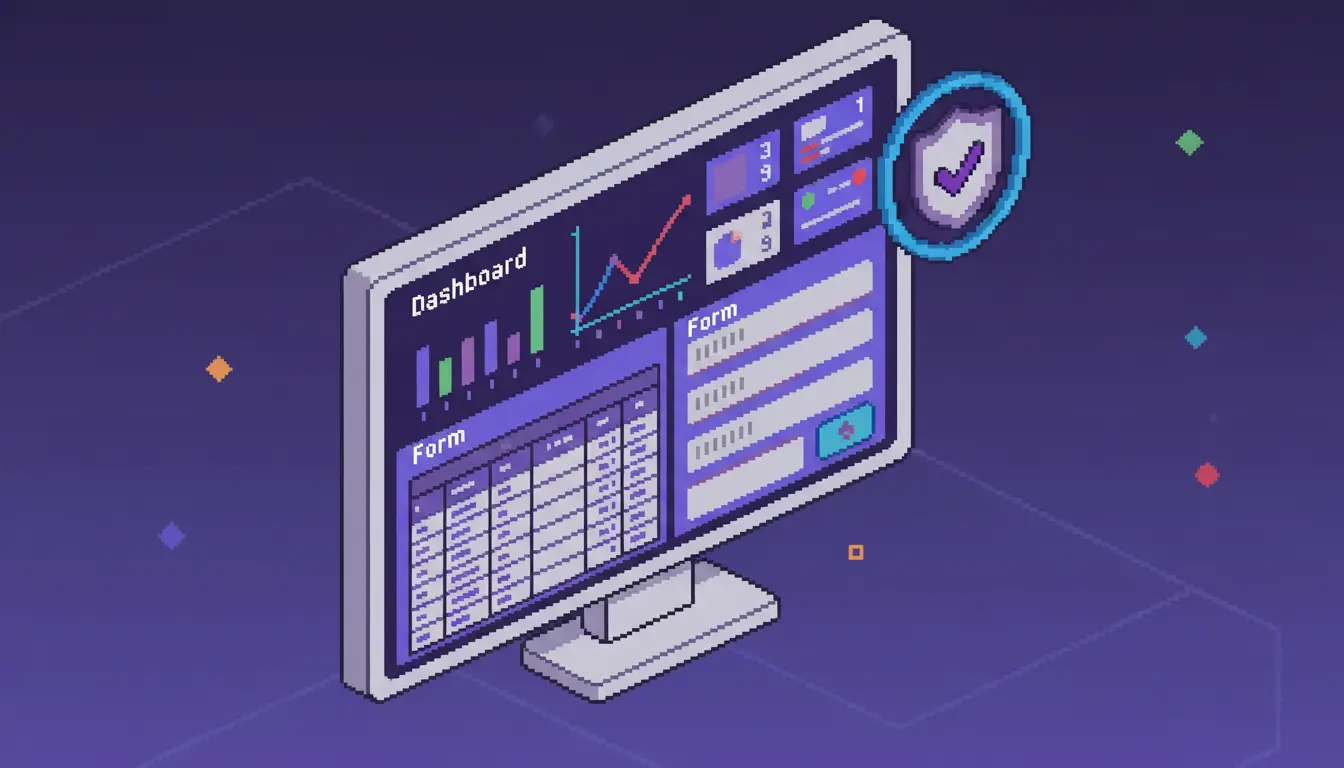
Learn how to create complete admin panels with forms, tables, authentication, and business process automation using Python alone—without switching to JavaScript.
Tom Gotsman