Top Python Web Development Frameworks in 2026
A comprehensive comparison of Reflex, Django, Flask, Gradio, Streamlit, Dash, and FastAPI—the top Python web frameworks in 2026 for full-stack and data apps.
Tom Gotsman
Python remains one of the world's most popular programming languages, with over 16 million developers and a community that continues to expand. Its appeal spans data scientists, machine learning engineers, and backend developers alike, thanks to its readable syntax and extensive library ecosystem.
The Python landscape offers frameworks for nearly every use case, whether you're building full-stack web applications or creating data visualizations. While this thriving ecosystem provides developers with numerous options for web development, the abundance of choices can make selecting the ideal framework for your specific project a challenge.
To help you navigate these options, we've put together a comprehensive comparison of the leading Python web frameworks, examining what each does best and where they fall short. Here are the frameworks we'll cover:
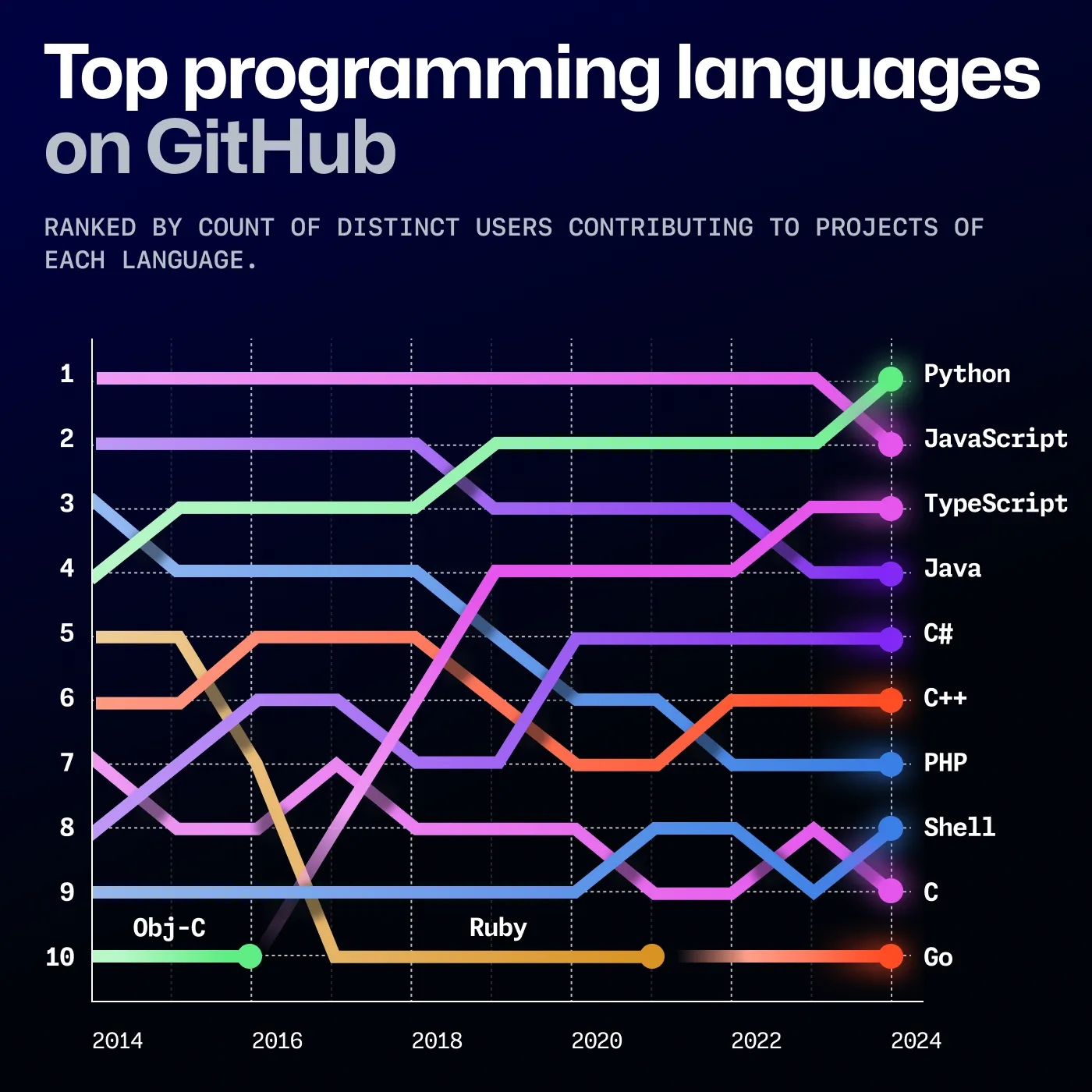
Github top programming languages 2024
Reflex is transforming web development by letting developers build complete web applications in a single language: Python. It bridges the gap between backend and frontend seamlessly, offering more than 60 built-in components that are easy to customize and extend. Developers can also incorporate their own components, with React powering everything under the hood.
Pros
- Pure Python: Write both your frontend and backend code entirely in Python.
- No boilerplate: The framework automatically manages the connection between your frontend and backend.
- Flexible and expressive: Choose from over 60 UI components with extensive customization options (Tailwind, custom CSS, and more).
- Database management: Built-in SQLAlchemy integration with native support for SQLite, Postgres, and MySQL.
- Authentication: Multiple auth options available, from Local Auth and Google Auth to Magic Link, Captcha, Descope, and Clerk Auth for streamlined user management.
- Deployment: Deploy your apps to the cloud using a single command (
reflex deploy).
Cons
- Ecosystem: As a newer framework, Reflex has a smaller plugin ecosystem compared to established options like Django. That said, with over 20k GitHub stars, it's among the fastest-growing Python frameworks.
- Breaking changes: The framework is still evolving, which means APIs may change between versions.
Django is a well-established, "batteries included" framework backed by a vast ecosystem of plugins for authentication, admin interfaces, content management, and much more. Having been around for many years, Django boasts both a large community and a proven track record in production environments.
Pros
- Mature: Years of development have resulted in a robust ecosystem and active community.
- Admin interface: A built-in admin panel makes content management and data administration straightforward.
- ORM: Django's integrated database ORM simplifies database interactions.
- Plugin system: Easily extend functionality through Django's plugin architecture, integrating tools for authentication, payments, analytics, and beyond.
- Security: Comprehensive built-in security protections against SQL injection, cross-site scripting (XSS), and cross-site request forgery (CSRF).
Cons
- Frontend: You'll need a separate frontend framework, as Django's HTML templating system doesn't match the capabilities of modern technologies like React.
- Performance: Django doesn't match FastAPI's performance, which was built specifically with async and ASGI in mind.
- Monolithic: The monolithic architecture can present challenges when scaling large web applications.
Flask is a lightweight micro framework that's quick to learn and well-suited for microservices and smaller web applications. Its simplicity and flexibility have made it a popular choice for building Python APIs.
Flask vs Django:
Flask excels when you need simplicity and the freedom to select your own components. Django, on the other hand, provides a more complete solution with built-in features for common tasks like authentication and admin interfaces. This makes Flask ideal for small to medium-sized projects and API development, while Django is better suited for larger, more complex applications that benefit from an all-in-one approach.
Pros
- Lightweight: Easy to learn and quick to get started with minimal overhead.
- Flexible: A minimalist approach that provides a solid foundation for custom development.
- Customizable: The modular architecture lets you choose exactly which extensions and libraries to include, adapting to various use cases.
- Large ecosystem: A mature collection of extensions for database integration, authentication, and other common needs.
Cons
- Synchronous: Runs synchronously by default, which can limit performance in demanding applications.
- Jinja templating: Most Flask apps use Jinja templates, which lack the power and modern features of frameworks like React.
- Documentation: Unlike FastAPI, generating API documentation requires additional libraries.
- Scaling: The simplicity that makes Flask appealing can become a limitation in large, complex projects that require more structure.
Streamlit has become increasingly popular among data scientists for quickly turning Python scripts into interactive web applications with minimal code. It's great for prototyping, building dashboards, and presenting data insights, though it's less suitable for apps that need complex interfaces or persistent interactivity.
Pros
- Quick prototyping: Rapidly transform Python scripts into functional web applications with minimal effort.
- Data visualization: Built-in components for common visualization tasks make it perfect for dashboards.
- Ease of use: The declarative syntax lets developers focus on functionality instead of boilerplate.
- Community-driven examples: A rich app gallery on GitHub showcases examples and templates for building various Streamlit applications.
Cons
- Execution Inefficiency: The entire application re-runs on every input change, creating inefficiencies for complex workflows or large datasets that update frequently.
- Limited UI components: Offers fewer UI elements than frameworks like Reflex or React, limiting options for complex, custom interfaces.
- Scalability: Not designed for long-running or highly interactive applications with complex workflows.
- State management: Handling application state becomes increasingly difficult as apps grow more complex.
- Caching complications: While caching can improve performance, it introduces challenges like high memory usage, slower performance, or stale data. Poor cache invalidation can lead to unpredictable behavior.
Gradio is an open-source Python library for building user-friendly web interfaces around machine learning models. It's particularly popular for prototyping, demonstrating, and sharing ML models with minimal configuration. With seamless integration into TensorFlow, PyTorch, and Hugging Face, Gradio has become a favorite among ML practitioners.
Pros
- Easy deployment: Deploy apps quickly, including directly to Hugging Face Spaces for effortless sharing.
- ML integration: Works seamlessly with popular ML libraries like TensorFlow, PyTorch, and Hugging Face, streamlining ML workflows.
Cons
- Limited scope: Best for ML experimentation and demos rather than production-grade or complex web applications.
- Customization limitations: Building highly customized interfaces often requires additional JavaScript or external libraries.
- Scalability: May not scale well for large-scale production deployments.
Dash is a Python framework designed for building interactive analytical web applications. Built on Flask, Plotly.js, and React.js, it provides a powerful environment for dashboards and data apps. Dash applications consist of two main parts: layout (defining the visual structure with HTML and React components) and callbacks (handling interactivity by responding to user inputs).
The framework is optimized for deployment efficiency, with independent components that enable easy horizontal scaling. The trade-off is that callbacks must be stateless and self-contained, which can be challenging for developers accustomed to stateful programming.
Pros
- Rich data components: An extensive library of pre-built visualization and UI components makes it ideal for analytical applications.
- Multi-language support: Works with Python, R, and Julia, serving the scientific and data communities.
- Academic backing: As one of the earliest Python data visualization frameworks, Dash has strong academic community support.
- Plotly integration: Leverages Plotly.js for highly customizable, interactive visualizations.
- Deployment efficiency: The architecture supports easy horizontal scaling for distributed environments.
Cons
- Callback complexity: Managing interactivity through callbacks can become complicated in larger applications, as each component must operate independently without global variables or stored states.
- Cloud deployment: Plotly's hosting service targets enterprise users, and container deployment adds complexity for individual developers or smaller teams.
FastAPI is a modern backend framework that has gained significant popularity for REST API development. Built on Starlette and Pydantic, it delivers excellent performance and developer ergonomics, particularly for high-concurrency scenarios.
Pros
- Type hints: Uses Python type hints to improve code quality and simplify API interactions.
- Automatic documentation: Generates OpenAPI (Swagger) documentation automatically from your type hints.
- Data validation: Pydantic integration makes request and response validation straightforward.
- Performance: Delivers exceptional performance, often matching or exceeding Node.js and Go in benchmarks.
- Asynchronous support: Native async support makes it well-suited for high-concurrency applications.
Cons
- Frontend: No built-in frontend framework, requiring integration with a separate solution.
- Onboarding: Can be challenging for developers new to web deployment, though it works well for small to medium-sized organizations.
- Limited built-in features: Focused on backend APIs, lacking built-in features for authentication, admin panels, or templating that full-stack frameworks like Django provide.
Reflex extends FastAPI by adding a frontend layer and eliminating the boilerplate needed to connect backend and frontend. This significantly simplifies full-stack development. When deployed, Reflex apps compile to a FastAPI backend paired with a React frontend.
Selecting the right Python framework depends on your specific requirements, the type of application you're building, project complexity, and your preferred development approach.
- Reflex is an excellent option for building interactive, full-stack applications entirely in Python, seamlessly handling both frontend and backend.
- Django suits larger projects requiring comprehensive features and tools, providing everything needed for complex backend operations.
- Flask works best for smaller projects or microservices where flexibility and a lightweight footprint are priorities.
- Streamlit and Plotly Dash excel at data-focused applications. Streamlit is ideal for quick prototypes that will remain simple, though its architecture can cause issues as complexity grows. Dash is better suited for detailed dashboards and visualizations.
- Gradio is the go-to choice for ML practitioners who need to quickly create and share interactive model interfaces.
- FastAPI is the best option for building fast, efficient APIs, particularly for applications requiring high performance and concurrent request handling.
Every framework has its own strengths and trade-offs. Understanding what each does best will help you choose the one that aligns with your project goals and development workflow.
More Posts

Learn how to create complete admin panels with forms, tables, authentication, and business process automation using Python alone—without switching to JavaScript.
Tom Gotsman
Compare Reflex.build, Microsoft Power Apps, Superblocks, Blaze.tech, Knack, Lovable.dev, and Replit Agent for enterprise AI app development in 2026.
Tom Gotsman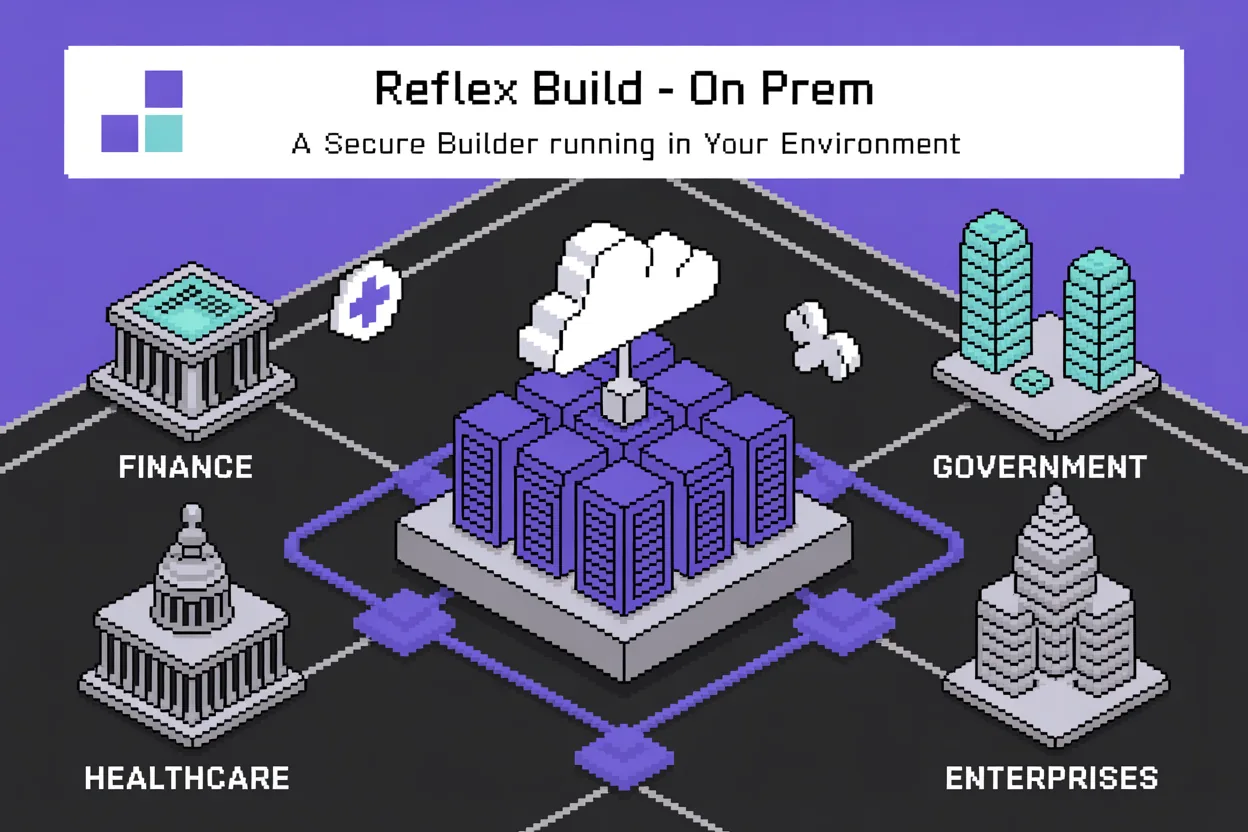
Reflex Build on-premises—an enterprise AI app builder for developing secure internal tools and dashboards using Python. Deploy inside your infrastructure.
Alek Petuskey